
There was a time when job searching felt like a numbers game.
Send 100 CVs.
Hope 10 people open them.
Pray 3 reply.
Pretend rejection emails are “market feedback” and carry on.
But in 2026, that approach is becoming less effective and far more exhausting.
Job seekers are applying in higher volumes, employers are receiving more applications, and recruiters are increasingly using AI-powered tools and applicant tracking systems to manage the flood. LinkedIn’s recruiting research shows that AI is now being used to help recruiters analyse resumes, uncover skills, automate assessments, and support skills-based hiring decisions. SHRM also notes that AI recruiting tools can scan resumes and cover letters for words or phrases that match job descriptions.
So, if your strategy is “I’ll just apply to everything with the same CV,” you are not being efficient.
You may simply be getting filtered faster.
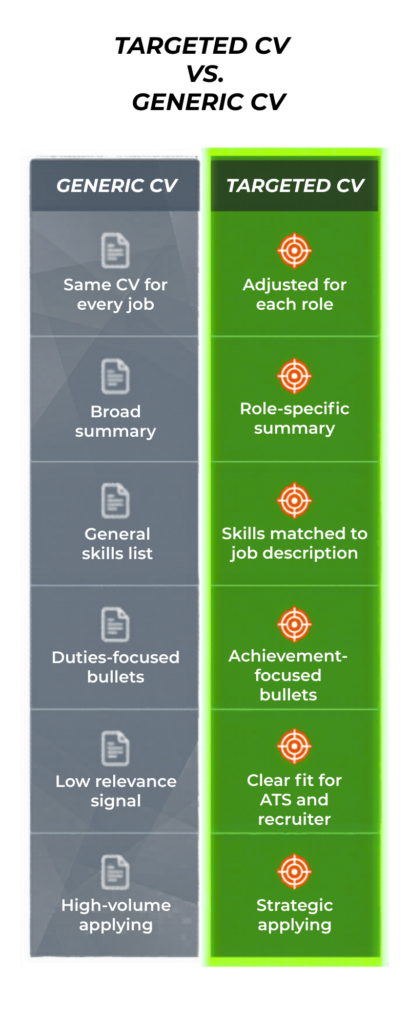
The difference between a targeted CV and a generic CV
A generic CV is the same document sent to every employer. It usually lists your education, work history, skills, and responsibilities in a broad way. It may be well-written, but it is not clearly aligned to one specific role.
A targeted CV is adapted for a specific job. It does not mean inventing experience or rewriting your whole career every time. It means presenting your most relevant skills, keywords, achievements, and evidence in the language of the role you are applying for.
Think of it this way:
A generic CV says, “Here is everything I have done.”
A targeted CV says, “Here is why I match this role.”
That difference matters.
Why volume applying fails in 2026
The problem with volume applying is not only that it is lazy. Sometimes it is not lazy at all. Many job seekers are genuinely stressed, under pressure, and trying to increase their chances by applying everywhere.
The issue is that volume applying often creates low-quality matches.
In today’s hiring environment, employers are not just looking for someone who has “experience.” They are looking for evidence that your experience fits their job description, team needs, tools, industry, and outcomes.
LinkedIn’s Future of Recruiting report highlights the growing importance of skills-based hiring, with talent acquisition professionals placing more focus on accurately assessing what candidates can actually do. That means a CV that hides your relevant skills under vague job duties can easily underperform — even if you are qualified.
This is why someone can apply to 80 jobs and hear nothing, while another person applies to 12 carefully selected jobs and gets interviews.
It is not always about who is better.
Sometimes it is about whose CV makes the match easier to see.
The generic CV problem: it tries to speak to everyone
A generic CV usually fails because it is trying too hard to cover every possibility.
It may say things like:
“Responsible for managing daily operations.”
“Worked with stakeholders.”
“Supported projects.”
“Handled administrative tasks.”
“Excellent communication skills.”
There is nothing wrong with these phrases on the surface. The problem is that they are too broad. They do not show the recruiter what kind of operations, which stakeholders, what type of projects, what results, or how your communication helped the business.
A recruiter does not have time to decode your entire career.
An ATS will not politely think, “Hmm, maybe this person has the skills we need but used different wording.”
In many cases, your CV must create a clear bridge between your experience and the job description.
A generic CV often leaves that bridge unfinished.
The targeted CV advantage: relevance
A targeted CV does not mean changing your identity for every job.
It means changing the emphasis.
For example, if you are applying for a QA Software Tester role, your CV should not bury your testing experience beneath general IT support, customer service, or admin duties. Your strongest testing-related evidence should appear early and clearly.
If the job description asks for:
- Test case design
- Regression testing
- Defect tracking
- Agile collaboration
- API testing
- Automation exposure
Your CV should show those skills in your profile, skills section, and work experience — with evidence.
Not like this:
“Worked on software testing projects.”
Better:
“Designed and executed functional, regression, and exploratory test cases for web applications, logging defects in Jira and collaborating with developers during sprint cycles to improve release quality.”
That is still honest. It is just more useful.
Why ATS-friendly does not mean keyword stuffing
One mistake many job seekers make is thinking “ATS-friendly” means copying and pasting the job description into the CV.
Please do not do that.
Recruiters can spot keyword stuffing quickly, and modern hiring tools are becoming more sophisticated. The goal is not to trick the system. The goal is to help both the system and the human reader understand your relevance. Indeed’s guide to creating an ATS-friendly CV also reinforces the importance of clear formatting, standard headings, and relevant keywords.
A strong targeted CV uses keywords naturally.
For example, if the job description mentions “stakeholder management,” and you genuinely have that experience, include it in context:
“Coordinated with product owners, developers, and business stakeholders to clarify requirements and resolve defects before release.”
That is better than dropping “stakeholder management” into a random skills list and hoping for magic.
Keywords open the door, but evidence keeps you in the room.
What should you tailor in your CV?
You do not need to rewrite the whole CV for every job. That is how people burn out and start questioning all their life choices over a job advert asking for “entry-level experience” and five years of Python.
Focus on these areas.
1. The professional summary
Your summary should match the role you want, not just describe your entire career.
A generic summary might say:
“Hardworking professional with experience in administration, customer service, technology, and project support.”
A targeted summary might say:
“Detail-oriented QA professional with experience in test case design, defect tracking, regression testing, and cross-functional collaboration. Skilled at identifying quality risks, documenting issues clearly, and supporting reliable software releases.”
The second version is sharper because it tells the employer what to do with you.
2. The skills section
A generic skills section is often a long shopping list.
Microsoft Office. Communication. Leadership. Teamwork. Problem-solving. Time management.
These are fine, but they are not enough.
A targeted skills section should reflect the job description. For example:
Technical Skills: Manual Testing, Regression Testing, Test Case Design, Jira, Zephyr, API Testing, SQL Basics, Agile/Scrum
Professional Skills: Requirement Analysis, Defect Documentation, Risk-Based Testing, Stakeholder Communication
This gives both ATS tools and recruiters a clearer match.
3. Work experience bullets
This is where many CVs lose power.
A targeted CV should not only list duties. It should show outcomes.
Instead of:
“Responsible for testing software.”
Try:
“Executed regression and functional testing across key user journeys, identifying defects before release and supporting smoother production deployments.”
Instead of:
“Worked with teams.”
Try:
“Collaborated with developers, product owners, and business stakeholders to clarify acceptance criteria and reduce rework during sprint delivery.”
The more specific you are, the harder it is for your CV to sound like everybody else’s.
4. Job titles and context
Sometimes your official job title does not fully explain what you did.
For example, “Associate” could mean anything. “Analyst” could mean anything. “Coordinator” could mean anything.
You can add context without changing your title dishonestly:
Operations Associate — Process Improvement & Reporting Support
QA Analyst — Web Application Testing
Administrative Coordinator — Healthcare Scheduling & Compliance Support
This helps the recruiter understand your relevance faster.
5. Achievements and metrics
Numbers make your CV more believable.
You do not need dramatic numbers. Even small metrics help.
Examples:
- Reduced manual testing time by 20% through reusable test cases
- Reviewed 150+ customer records weekly with high accuracy
- Supported monthly reporting for 5 departments
- Resolved 30+ support tickets per week
- Improved document turnaround time from 5 days to 2 days
Metrics turn “I helped” into “Here is the impact.”
Targeted does not mean fake
Let’s be clear: tailoring your CV is not the same as lying.
A targeted CV does not add skills you do not have. It does not inflate your job title. It does not pretend you used tools you have only seen once on YouTube at 1 a.m.
It simply brings the most relevant truth to the front.
You are allowed to reposition your experience.
You are allowed to use the employer’s language.
You are allowed to make your value obvious.
A CV is not a confession document where every task you have ever done must receive equal space. It is a marketing document backed by evidence.
How to target your CV without spending three hours on every application
The good news is that you do not need to start from scratch each time. For a faster step-by-step routine, read The 60-Minute Resume Refresh before you apply anywhere.
Use this simple process.
Step 1: Read the job description properly
Do not just look at the job title. Job titles lie.
Two companies can advertise the same title and expect completely different things. One “Project Coordinator” role may be admin-heavy. Another may require stakeholder reporting, risk tracking, and budget support.
Look for repeated themes in the job description.
What skills appear more than once?
What tools are mentioned?
What outcomes does the employer care about?
What problems will this person solve?
Step 2: Highlight the top 6–8 requirements
Do not try to match everything. Focus on the important requirements.
For example:
- Customer service
- CRM system experience
- Complaint resolution
- Data accuracy
- Reporting
- Team collaboration
- Process improvement
These become your targeting guide.
Step 3: Adjust your summary and skills
Your summary and skills section should reflect the strongest overlap between your experience and the job.
This is where you make the first match obvious.
Step 4: Reorder your bullets
You may already have the right experience in your CV, but it may be buried.
Move the most relevant bullet points higher under each role.
Recruiters skim. Put your strongest evidence where their eyes will land first.
Step 5: Add missing context
If the job description mentions compliance, reporting, leadership, customer retention, stakeholder engagement, or risk management and you have done those things — say so clearly.
Do not assume the reader will infer it.
They will not. They have 200 CVs and probably cold coffee.
Step 6: Save role-specific versions
Create versions by job type, not by every single employer.
For example:
- QA Tester CV
- Customer Success CV
- Project Coordinator CV
- Business Analyst CV
- Healthcare Administration CV
- Cybersecurity Entry-Level CV
Then adapt each version lightly for each job.
That gives you speed without falling back into generic applying.
Quality applying beats volume applying
This does not mean you should apply to only one job per week and wait beside your inbox like it owes you money.
You still need consistency.
But there is a difference between strategic volume and panic volume.
Panic volume says:
“I applied to 70 jobs this week with the same CV.”
Strategic volume says:
“I applied to 15 roles that fit my experience, using a targeted CV for each job family.”
The second approach is more sustainable, more professional, and more likely to produce interviews.
In 2026, job search success is not just about how many applications you send. It is about how clearly each application proves fit.
Signs your CV is too generic
Your CV may be too generic if:
- Your summary could apply to almost any job
- Your skills section is mostly soft skills
- Your bullet points describe duties but not outcomes
- You use the same CV for different industries and roles
- You rarely include keywords from the job description
- Your CV does not clearly show what role you are targeting
- You apply often but rarely get interview invitations
The painful truth? A generic CV can make a qualified person look average.
And average does not stand out in a crowded inbox.
A quick example: generic vs targeted CV bullet
Let’s say the original bullet is:
“Responsible for customer service and resolving issues.”
For a customer support role, target it like this:
“Resolved customer enquiries through email and phone support, documenting issues accurately and improving response consistency.”
For an operations role:
“Managed daily customer issue logs, identified recurring service problems, and supported process improvements to reduce repeat enquiries.”
For a team lead role:
“Supported junior team members in handling escalated customer issues, improving service consistency and team response quality.”
Same experience. Different emphasis.
That is targeting.
The 2026 CV rule: make the match obvious
Your CV should not make employers work hard to understand your value.
That is the real issue with generic CVs. They require too much interpretation.
In a slower hiring market, maybe someone would take time to connect the dots. In a high-volume, AI-assisted hiring market, unclear CVs are easier to skip.
A targeted CV does three things well:
It mirrors the role without copying it.
It proves the required skills with evidence.
It helps both ATS tools and human recruiters understand fit quickly.
That is the sweet spot.
Final thoughts
Volume applying feels productive because it gives you something to count. But job searching is not only about activity. It is about alignment. A generic CV may help you apply faster, but a targeted CV helps you apply better. And in 2026, better matters more than ever.
Before sending your next application, pause for ten minutes and ask:
Does this CV clearly show why I fit this role?
If the answer is no, do not send it yet. Because the goal is not to apply everywhere. The goal is to be seen where you actually belong.