Writing an entry-level CV with no experience can feel like trying to open a locked door with a spoon.
You want the job, you know you can learn, and you may even be more motivated than some experienced candidates. But the job advert keeps asking for “1–2 years of experience,” “proven track record,” or “hands-on exposure,” and you are wondering:
How do I prove I can do the job when nobody has given me the job yet?
Here is the good news: recruiters are not only looking for paid work experience. They are looking for evidence.
That evidence can come from school projects, volunteer work, internships, online courses, leadership roles, part-time jobs, personal projects, certifications, competitions, caregiving responsibilities, community work, and even the way you present your CV.
The mistake many entry-level candidates make is writing a CV that says, “I am hardworking, motivated, and willing to learn.”
That is nice. But recruiters trust proof signals, not personality slogans.
This article breaks down 10 proof signals recruiters trust when reviewing an entry-level CV with no formal work experience.
Why “No Experience” Does Not Mean “Nothing to Offer”
Let us clear this up first: “No experience” usually means no direct paid experience in that exact role.
It does not mean you have no transferable skills, no achievements, no learning history, no discipline, no communication ability, and no proof that you can solve problems.
Recruiters know entry-level candidates are still building. They are not expecting you to have managed a global product launch, led a finance department, or saved a company from total collapse before lunch.
What they do expect is a CV that answers this question:
Can this person learn quickly, communicate clearly, complete tasks reliably, and bring useful skills into the role?
Your job is to make the answer easy to see.
Career experts recommend using education, skills, projects, and volunteer experience when writing a resume with no formal work history.
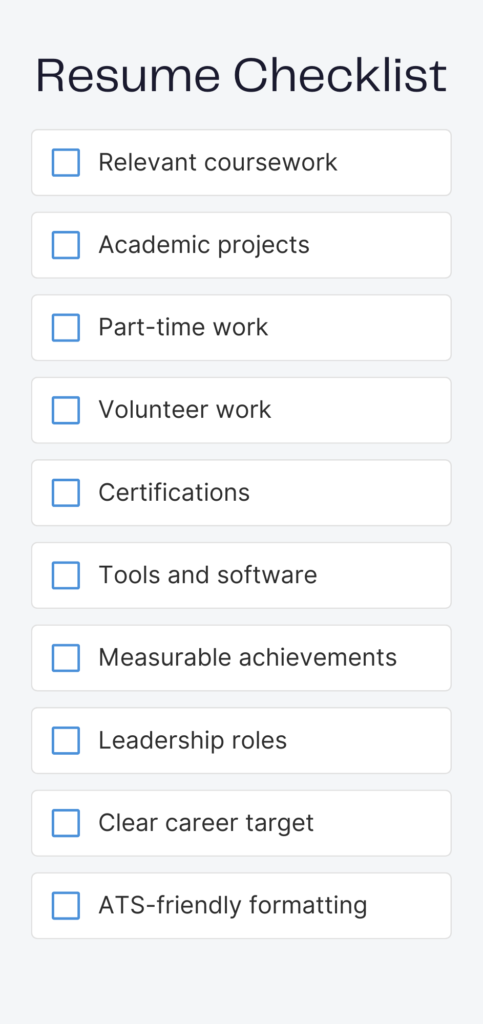
1. Relevant Coursework That Connects to the Job
Coursework can be a strong proof signal when it is selected carefully.
The problem is that many candidates list every course they have taken, including the ones that have nothing to do with the role. That makes the CV look unfocused.
Instead, choose courses that connect directly to the job description.
For example, if you are applying for a marketing assistant role, relevant coursework might include:
Relevant Coursework:
Digital Marketing, Consumer Behavior, Business Communication, Market Research, Social Media Strategy
If you are applying for an entry-level cybersecurity role:
Relevant Coursework:
Network Security, Information Systems, Linux Fundamentals, Risk Management, Database Security
This tells the recruiter, “I may be new, but I have studied the foundation of this field.”
Even better, combine coursework with outcomes:
Example:
Completed coursework in Network Security, Linux Fundamentals, and Risk Management, with hands-on assignments involving vulnerability identification, access control concepts, and incident response basics.
That sounds much stronger than simply listing “Computer Networks.”
2. Academic or Personal Projects
Projects are one of the most powerful proof signals on an entry-level CV.
Why? Because projects show action.
They prove that you did more than attend class or watch tutorials. You applied knowledge to create, analyze, test, research, design, present, or solve something.
A project does not need to be huge. It only needs to be relevant and clearly explained.
Weak version:
Did a school project on marketing.
Stronger version:
Developed a social media marketing plan for a small business concept, including target audience research, content themes, competitor analysis, and weekly engagement metrics.
For a technical role:
Built a basic network security lab using virtual machines to practice user access controls, firewall rules, and vulnerability scanning.
For a business role:
Created a business plan for a startup concept, including market segmentation, pricing strategy, SWOT analysis, and financial assumptions.
The key is to describe:
What you did + what tools or methods you used + what the result was.
Recruiters trust projects because they show initiative and practical thinking.
3. Transferable Skills From Part-Time or Casual Work
Many entry-level candidates hide their part-time jobs because they think retail, food service, tutoring, babysitting, delivery work, or campus jobs are “not professional enough.”
That is a mistake.
Part-time jobs can prove communication, responsibility, time management, customer service, conflict resolution, cash handling, attention to detail, teamwork, and reliability.
These are real workplace skills.
Instead of writing:
Worked as a cashier.
Write:
Served 60+ customers per shift, processed payments accurately, resolved routine customer questions, and maintained a clean checkout area during peak hours.
Instead of:
Helped at family business.
Write:
Supported daily operations in a family-owned business by organizing inventory, assisting customers, tracking orders, and handling basic administrative tasks.
Do not undervalue ordinary work. Recruiters often respect it because it shows discipline and consistency.
A candidate who has balanced school and part-time work may already understand deadlines, pressure, and accountability better than someone who has only studied theory.
4. Volunteer Work and Community Involvement
Volunteer work can be excellent evidence, especially when it shows service, leadership, planning, communication, or responsibility.
The mistake is writing it too vaguely.
Weak version:
Volunteered at church/community event.
Stronger version:
Assisted with planning and registration for a community outreach event serving 150+ attendees; coordinated sign-in, answered visitor questions, and supported event setup and cleanup.
For nonprofit or healthcare-related roles:
Volunteered at a local food distribution program, helping organize supplies, register participants, and distribute essential items to community members.
For education roles:
Tutored younger students in math and reading, preparing weekly practice materials and tracking improvement areas.
Volunteer work tells recruiters that you are active, dependable, and willing to contribute beyond yourself. That is a strong signal, especially for entry-level roles.
5. Certifications and Online Learning
Certifications can help your CV, but only when they are relevant.
A certificate does not automatically make you qualified. But it can show that you are serious about learning and building skills outside the classroom.
Good certification proof signals include:
For tech roles:
Google IT Support Certificate, CompTIA A+, Cisco Networking Basics, Microsoft Azure Fundamentals, AWS Cloud Practitioner
For business roles:
Google Analytics, HubSpot Content Marketing, Microsoft Excel, Project Management Foundations
For administrative roles:
Microsoft Office Specialist, Excel, data entry, bookkeeping basics, customer service training
For healthcare/public health roles:
HIPAA training, basic life support, public health foundations, data privacy training
How to write it:
Completed Google IT Support Professional Certificate covering troubleshooting, networking, operating systems, system administration, and security fundamentals.
Or:
Earned Microsoft Excel certification with training in formulas, pivot tables, data cleaning, and spreadsheet reporting.
This gives the recruiter more detail than simply listing the certificate name.
6. Tools, Software, and Technical Skills
Recruiters often scan entry-level CVs for tools.
Even if you do not have job experience, knowing the tools used in the role can help you pass the first screening.
For example:
Marketing: Canva, Google Analytics, Mailchimp, WordPress, Meta Business Suite, Hootsuite
Business/Admin: Microsoft Excel, Google Workspace, PowerPoint, QuickBooks, CRM systems
Tech: Python, SQL, GitHub, Linux, Wireshark, VS Code, Jira
Design: Figma, Adobe Express, Canva, Photoshop
Data: Excel, Tableau, Power BI, SPSS, R, Python, SQL
But be honest. Do not list tools you cannot explain in an interview.
A better format is to group your skills:
Technical Skills: Microsoft Excel, PowerPoint, Google Workspace, Canva, WordPress
Data Skills: Pivot tables, data cleaning, basic reporting, spreadsheet analysis
Communication Skills: Presentation writing, customer service, email communication, team collaboration
This makes your CV easier to scan and more ATS-friendly.
7. Measurable Achievements, Even Small Ones
Numbers build trust.
Many entry-level candidates think they have no achievements because they have not worked in a corporate role. But achievements can come from school, volunteering, projects, part-time jobs, clubs, and personal initiatives.
Ask yourself:
How many people did I help?
How many hours did I volunteer?
How many customers did I serve?
How many students did I tutor?
How many pages, reports, presentations, or projects did I complete?
Did I improve speed, organization, accuracy, engagement, or quality?
Examples:
Completed a 12-week group project and presented findings to a class of 35 students.
Managed weekly content posts for a student club Instagram page, increasing engagement through consistent posting and event reminders.
Volunteered 40+ hours supporting food distribution and participant registration.
Created a 15-slide business presentation analyzing customer segments, pricing, and competitor positioning.
These are not “tiny” achievements. They are proof that you can complete real tasks.
Recruiters do not need you to sound like a CEO. They need you to sound credible.
8. Leadership Roles, Even Informal Ones
Leadership does not always mean job title.
If you organized a group project, trained a new volunteer, coordinated a student event, led a study group, managed household responsibilities, supported a family business, or helped others stay on track, that can count.
The key is to describe the responsibility professionally.
Weak version:
Helped group members with project.
Stronger version:
Coordinated a five-member class project by assigning sections, setting internal deadlines, compiling research, and preparing final presentation slides.
Another example:
Led a student study group of six peers, organizing weekly review sessions and practice questions before exams.
Recruiters trust leadership signals because they show initiative, maturity, communication, and ownership.
Even informal leadership can help your entry-level CV stand out.
9. A Clear Career Target
One of the biggest problems with entry-level CVs is that they look like they are trying to apply to everything.
A CV that says “open to any opportunity” may sound flexible, but it often feels unfocused. This is why a targeted CV performs better than a generic CV when applying for entry-level roles.
Recruiters want to know what direction you are moving toward.
Instead of a generic objective like:
Seeking a challenging role where I can grow and use my skills.
Try something more specific:
Entry-level business graduate with coursework in market research, consumer behavior, and digital marketing. Skilled in Canva, Excel, and social media content planning, with project experience developing customer-focused marketing strategies.
For tech:
Entry-level cybersecurity student with hands-on coursework in networking, Linux, and information security. Familiar with basic vulnerability scanning, access control concepts, and technical troubleshooting.
For admin:
Detail-oriented entry-level administrative candidate with experience in customer service, document organization, scheduling support, and Microsoft Office tools.
A clear target helps recruiters understand where to place you.
Your CV should not say, “I will do anything.”
It should say, “Here is the kind of role I am prepared for, and here is my proof.”
10. Professional Presentation and ATS-Friendly Formatting
This may sound simple, but formatting is a proof signal too.
A messy CV can make a recruiter doubt your attention to detail before they even read your content.
For an entry-level CV, keep the structure clean:
Recommended CV sections:
- Contact Information
- Professional Summary
- Education
- Relevant Skills
- Projects
- Work Experience or Volunteer Experience
- Certifications
- Leadership or Activities
Avoid:
Tiny fonts
Long paragraphs
Unlabeled sections
Unnecessary photos
Overdesigned templates
Huge blocks of keywords
Spelling mistakes
Fake experience
Recruiters and ATS systems both prefer clarity.
Your CV should be easy to read, easy to search, and easy to understand.
That is not boring. That is strategic.
Example: Weak Entry-Level CV Bullet vs. Strong Proof Signal
Here is the difference proof makes.
Weak bullet:
Good communication and teamwork skills.
Stronger bullet:
Collaborated with four classmates to complete a market research project, preparing survey questions, summarizing findings, and presenting recommendations to the class.
The second bullet proves communication and teamwork without simply claiming them.
That is what recruiters trust.
What to Put on an Entry-Level CV With No Experience
Here is a simple formula:
Relevant education + practical projects + transferable skills + measurable proof + clear job target.
You do not need to pretend you have experience you do not have.
You need to translate what you already have into employer language.
For example:
| What You Have | How to Present It |
|---|---|
| Class assignment | Academic project |
| Helping at church | Volunteer coordination |
| Retail job | Customer service and cash handling |
| Group project | Team collaboration and presentation |
| Online course | Certification or professional development |
| Personal website | Digital portfolio project |
| Tutoring sibling/classmate | Teaching and communication experience |
| Club activity | Leadership and event support |
This is where many candidates lose opportunities. They have the experience, but they do not name it properly.
Entry-Level CV Summary Examples
Example 1: Business Graduate
Entry-level business graduate with coursework in marketing, consumer behavior, and business communication. Experienced in developing academic projects involving market research, customer segmentation, and presentation design. Skilled in Microsoft Excel, PowerPoint, Canva, and written communication, with strong attention to detail and a willingness to learn.
Example 2: Cybersecurity Student
Entry-level cybersecurity student with hands-on coursework in networking, Linux fundamentals, risk management, and information security. Familiar with basic troubleshooting, access control concepts, vulnerability scanning, and technical documentation. Strong analytical thinker with project experience in security-focused lab exercises and team-based problem solving.
Example 3: Administrative Assistant Candidate
Organized entry-level administrative candidate with experience in customer service, document preparation, scheduling support, and Microsoft Office tools. Able to communicate professionally, manage multiple tasks, and support daily office operations with accuracy and reliability.
Common Mistakes to Avoid
Do not fill your CV with empty phrases like “hardworking,” “team player,” and “fast learner” without evidence.
Do not copy a job description and paste keywords everywhere.
Do not hide part-time jobs just because they are not in your target industry.
Do not use one generic CV for every role.
Do not exaggerate your skill level.
Do not make the recruiter search for your proof.
Your CV should make the connection obvious.
Final Thought: Recruiters Trust Evidence, Not Hope
An entry-level CV with no experience is not weak because it lacks paid work history.
It becomes weak when it lacks proof.
Recruiters trust candidates who can show effort, learning, responsibility, communication, and practical application.
So instead of asking, “How do I write a CV when I have no experience?” ask:
What evidence do I already have that proves I can learn, contribute, and grow in this role?
That shift changes everything.
Your first CV does not need to be perfect. It needs to be clear, honest, targeted, and supported by proof signals.
That is how you move from “no experience” to “worth interviewing.”
Before sending your CV, check whether it clearly shows the proof signals recruiters actually trust. CoolaCV helps you compare your CV against a real job description, identify missing keywords, strengthen weak sections, and turn your existing experience into a more targeted, ATS-friendly application.