
Before you submit a job application, your resume should pass two important tests.
First, it should be easy for an Applicant Tracking System, or ATS, to read. Second, it should be clear enough for a recruiter or hiring manager to understand your value quickly.
Many job seekers focus only on making their CV or resume look attractive. That is useful, but it is not enough. A resume can look professional and still perform poorly if it is hard to scan, missing role-specific keywords, poorly structured, or too generic for the job being applied for.
This ATS evaluation checklist will help you review your resume before applying so you can improve your chances of getting through screening and moving closer to an interview.
What is an ATS Evaluation?
An ATS evaluation is a practical review of your resume to check whether it is readable, relevant, and properly aligned with the job description.
It is not just about passing software. A strong resume must work for both the system and the human reviewer. The ATS may help organize, scan, or filter applications, but recruiters still need to see a clear match between your experience and the role.
A good ATS evaluation checks:
- whether your resume format is readable
- whether your headings are clear
- whether your skills match the job description
- whether your work experience shows relevant achievements
- whether your CV is too generic
- whether your application is tailored to the specific role
The goal is not to trick the system. The goal is to make your resume easier to understand.
ATS Evaluation Checklist
Use the checklist below before submitting your next application.
1. Is Your Resume Saved in the Right File Format?
Most employers accept PDF or DOCX files. Unless the job posting gives a specific instruction, these are usually the safest options.
Before applying, check:
| Question | Pass/Fail |
|---|---|
| Did the employer request a specific file type? | |
| Is your resume saved as PDF or DOCX? | |
| Does the file open correctly after saving? | |
| Is the file name professional? |
A simple file name is better than something vague or messy.
Good examples:
John-Smith-CV.pdfJohn-Smith-Resume-QA-Engineer.pdfJohn-Smith-Project-Manager-CV.docx
Avoid file names like:
finalresumeNEW2.pdfmycvlatestedited.pdfresume_for_everything.docx
Your file name is a small detail, but it adds to the overall professionalism of your application.
2. Is Your Layout Easy to Read?
A resume should be clean, structured, and easy to scan. Complex designs may look impressive, but they can create problems if the ATS cannot read the information correctly.
Check your layout for:
| Item | Pass/Fail |
|---|---|
| Simple one-column layout | |
| Clear section spacing | |
| No excessive graphics or icons | |
| No important text hidden inside images | |
| No complicated tables or text boxes | |
| Consistent font size and formatting |
A clean layout helps both the ATS and the recruiter. If a recruiter has only a few seconds to scan your resume, structure matters.
3. Are Your Resume Headings Standard?
ATS systems and recruiters both rely on clear headings. Creative headings can confuse the structure of your resume.
Use standard headings such as:
- Professional Summary
- Work Experience
- Skills
- Education
- Certifications
- Projects
- Volunteering
- Technical Skills
Avoid unclear headings such as:
- My Journey
- What I Bring
- Career Story
- Things I Have Done
- Value Highlights
Those may sound personal, but they are less searchable and less direct.
Your resume should make it easy for the reader to find your experience, skills, and education without guessing.
4. Does Your Resume Match the Job Title?
One common mistake job seekers make is using the same resume for every role. That often creates a generic CV problem.
Before applying, ask:
| Question | Pass/Fail |
|---|---|
| Does your summary mention the target role or role type? | |
| Are your strongest experiences relevant to the job? | |
| Does your skills section reflect the job description? | |
| Are your recent achievements connected to the role? |
For example, if you are applying for a QA Automation Engineer role, your resume should not only say “software tester.” It should clearly show automation tools, test frameworks, API testing, CI/CD exposure, defect management, and measurable testing outcomes where relevant.
If you are applying for a Project Manager role, your resume should show delivery, stakeholder management, budgets, timelines, risk management, and measurable project outcomes.
The job title does not need to be repeated unnaturally, but the role alignment should be obvious.
5. Are the Right Keywords Included Naturally?
ATS evaluation is not about stuffing keywords. It is about showing that your experience matches the language of the job description.
Look at the job posting and identify repeated terms such as:
- tools
- certifications
- skills
- job titles
- methods
- industry terms
- responsibilities
- required experience
Then check whether your resume includes the most relevant ones.
For example, a QA role may include keywords such as:
- Selenium
- Cypress
- Postman
- API testing
- regression testing
- automation framework
- test cases
- defect tracking
- Jira
- CI/CD
A project management role may include:
- stakeholder management
- project planning
- Agile
- risk management
- budget tracking
- delivery timelines
- governance
- reporting
- cross-functional teams
Do not add keywords you cannot support. The strongest resume keywords are connected to real experience.
6. Are Your Bullet Points Specific and Measurable?
A resume that only lists duties can feel flat. A stronger resume shows what changed because of your work.
Weak bullet:
Responsible for testing software applications.
Stronger bullet:
Executed functional, regression, and API tests across multiple releases, helping reduce production defects and improve release confidence.
Even stronger if you have numbers:
Executed functional, regression, and API tests across multiple releases, helping reduce production defects by 30% and improve release readiness.
Use numbers where possible, such as:
- percentage improvement
- cost reduction
- time saved
- number of users supported
- number of projects delivered
- number of defects identified
- number of reports completed
- size of team supported
- process improvement results
If you do not have exact numbers, you can still be specific. Focus on scope, tools, outcomes, and impact.
7. Is Your Skills Section Too Generic?
A generic skills section is one of the easiest ways to weaken a resume.
Avoid broad skills like:
- communication
- leadership
- teamwork
- Microsoft Office
- hardworking
- problem solving
These may be true, but they are too common on their own.
Instead, use skills that match the role.
For a QA role:
- Test automation
- API testing
- Regression testing
- Cypress
- Selenium
- Postman
- Jira
- Test case design
- Defect reporting
- Performance testing
For a project management role:
- Risk management
- Stakeholder engagement
- Project governance
- Budget tracking
- Agile delivery
- Resource planning
- Change management
- Project reporting
- Vendor coordination
Your skills section should help the recruiter quickly understand what you can do.
8. Is Your Resume Too Generic?
A generic CV is a broad resume used for many applications without being tailored to a specific job. It may describe your background, but it does not clearly show why you fit the exact role.
Signs your resume may be too generic:
- the same version is used for every job
- your summary could apply to almost any role
- your skills section is broad and unfocused
- your bullet points list duties instead of outcomes
- the job description keywords are missing
- your strongest relevant experience is buried
A generic CV is not always useless. It can be a good starting document. But for actual job applications, a targeted CV usually works better because it connects your experience to the employer’s needs.
Before applying, ask:
If a recruiter reads this resume for 20 seconds, will they immediately understand why I match this role?
If the answer is no, your resume needs more targeting.
9. Is Your Contact Information Clear?
This sounds basic, but it is still important.
Check that your resume includes:
| Contact detail | Pass/Fail |
|---|---|
| Full name | |
| Professional email address | |
| Phone number, if appropriate | |
| City/country or location preference | |
| LinkedIn profile, if relevant | |
| Portfolio/GitHub/personal site, if relevant |
Avoid placing key contact information only in a header image, graphic, or text box that may not be read properly.
Also make sure your email address looks professional. A simple name-based email is best.
10. Are Your Dates and Job Titles Consistent?
Recruiters look for clarity. Inconsistent dates, unclear job titles, and unexplained gaps can create confusion.
Check:
- Are employment dates formatted consistently?
- Are job titles clear?
- Are company names spelled correctly?
- Are current roles marked accurately?
- Are overlapping dates explainable?
- Are career gaps addressed where necessary?
You do not need to over-explain every detail, but the timeline should be easy to follow.
11. Does the Resume Work for a Human Reader?
ATS readiness matters, but your resume is still written for people.
After checking formatting and keywords, read the resume like a recruiter.
Ask:
- Can I understand the candidate’s value in 30 seconds?
- Is the most relevant experience easy to find?
- Does the summary match the role?
- Are the bullet points clear?
- Is there too much jargon?
- Is the resume too long?
- Does it feel targeted or generic?
A resume that only satisfies software but fails to persuade a human reviewer is still weak.
12. Is There a Clear Match Between the Job Description and Your Resume?
This is the most important part of the ATS evaluation.
Before applying, compare the job description with your resume.
Look for:
| Job Description Requirement | Is It Reflected in Resume? |
|---|---|
| Required tools | |
| Required years or level of experience | |
| Main responsibilities | |
| Industry knowledge | |
| Certifications | |
| Technical skills | |
| Soft skills with evidence | |
| Measurable achievements |
If the job description asks for something important and your resume does not mention it, the recruiter may assume you do not have it.
This does not mean you should copy the job description word for word. It means you should translate your real experience into language that matches the role.
How to Score Your Resume
Use this simple scoring guide.
Give yourself one point for each section you can confidently pass:
- Correct file format
- Clean layout
- Standard headings
- Job-title alignment
- Relevant keywords
- Measurable bullet points
- Focused skills section
- Not too generic
- Clear contact information
- Consistent dates and titles
- Human readability
- Strong job-description match
Score Meaning
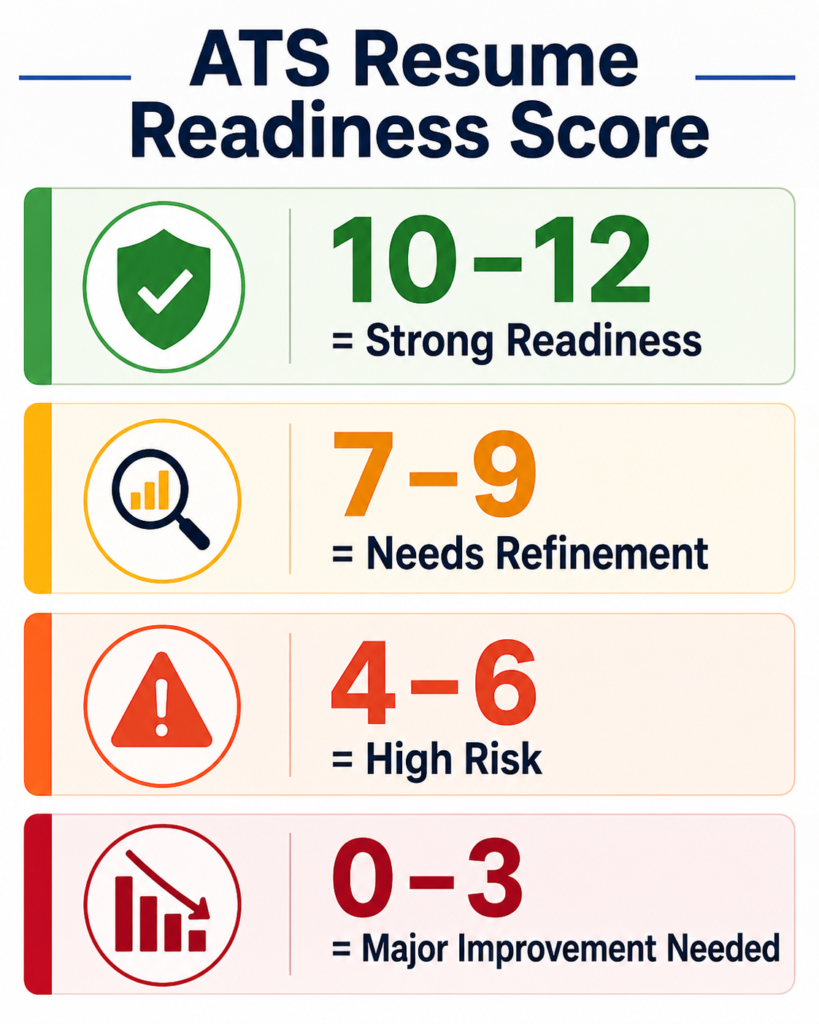
| Score | Meaning |
|---|---|
| 10–12 | Strong ATS and recruiter readiness |
| 7–9 | Good foundation, but needs refinement |
| 4–6 | High risk of being overlooked |
| 0–3 | Needs major improvement before applying |
If your score is below 7, do not rush to submit. Improve the resume first.
Common ATS Evaluation Mistakes
Mistake 1: Trying to Beat the ATS Instead of Helping It Read Clearly
The goal is not to trick the system. The goal is to make your resume clear, relevant, and easy to evaluate.
Mistake 2: Copying the Job Description Without Evidence
Adding keywords is not enough. You need to show where and how you used those skills.
Mistake 3: Using a Beautiful Design That Hides Important Information
Visual design should support readability, not replace it.
Mistake 4: Sending the Same Resume to Every Job
This is one of the biggest reasons qualified candidates get ignored. A resume should be adjusted for each serious application.
Mistake 5: Forgetting the Recruiter
Even if your resume passes the ATS, a human still needs to believe you are worth interviewing.
ATS Evaluation vs Resume Optimization
An ATS evaluation helps you identify whether your resume is readable, structured, and aligned with the job description.
Resume optimization goes further. It improves the wording, structure, keyword match, role relevance, and overall application strength.
That is where CoolaCV helps.
CoolaCV helps job seekers move from a generic CV to a targeted application by supporting:
- CV optimization
- cover letter creation
- application tracking
- interview preparation
Instead of guessing whether your resume is ready, you can use CoolaCV to make your application clearer, more targeted, and better aligned with the role.
Final ATS Evaluation Checklist Before You Apply
Before you click submit, ask yourself:
- Is my resume easy to read?
- Does it use standard headings?
- Does it match the job description?
- Have I included relevant keywords naturally?
- Are my achievements specific?
- Is my skills section focused?
- Does the resume clearly show why I fit this role?
- Would a recruiter understand my value quickly?
- Have I removed unnecessary generic content?
- Is my file name professional?
If the answer is yes to most of these, your resume is in a much stronger position.
If not, pause and improve it before applying.
Ready to Improve Your Resume?
A strong application starts before you click submit.
Use CoolaCV to review your CV, tailor it to the job description, prepare a stronger cover letter, track your applications, and get ready for interviews.
Start optimizing your CV with CoolaCV today.