
Most people update their career materials at exactly the wrong time.
It usually happens after the redundancy meeting, after a promotion goes to someone else, after a company announces a restructure, or after Sunday evening starts feeling much heavier than it used to. Then comes the frantic version of career planning: opening a CV that has not been touched in two years, trying to remember what you actually achieved at work, updating LinkedIn at midnight, and applying for anything that looks remotely suitable.
Career cushioning is supposed to prevent that. But somewhere along the way, the term became associated with quietly applying for jobs every evening just in case your current employer suddenly lets you go. That sounds less like cushioning and more like maintaining a permanent emergency.
A better approach is much simpler:
Spend 30 minutes each week keeping your career ready.
Not because you are planning to leave your job, and not because you expect something terrible to happen. The point is to make sure that opportunities, restructures, career changes, or unexpected problems do not catch you completely unprepared.
Think of it as routine maintenance for your professional life. You service your car before the engine breaks. Your career deserves at least half an hour.
First: What Career Cushioning Actually Means
Career cushioning is the practice of maintaining options outside your current role so that your income, career progression, and professional identity are not entirely dependent on one employer. That does not necessarily mean actively job hunting or applying to roles every week.
A well-maintained career cushion might simply mean that your CV reflects your current achievements, your LinkedIn profile accurately represents what you do, and you know what similar roles are paying. It can also mean staying aware of which skills employers are requesting, maintaining professional relationships outside your company, and having some idea where you would look if your situation changed.
The goal is optionality.
You should not need to rebuild your professional identity from scratch every time circumstances change. Unfortunately, a lot of career advice makes this sound like another major weekly commitment: track vacancies, network constantly, take courses, rewrite your CV, post on LinkedIn, attend events, contact recruiters, research companies, and somehow still do your actual job.
Most people will not maintain that routine for long.
So the system needs to be small enough to survive a busy Tuesday.
Thirty minutes is enough.
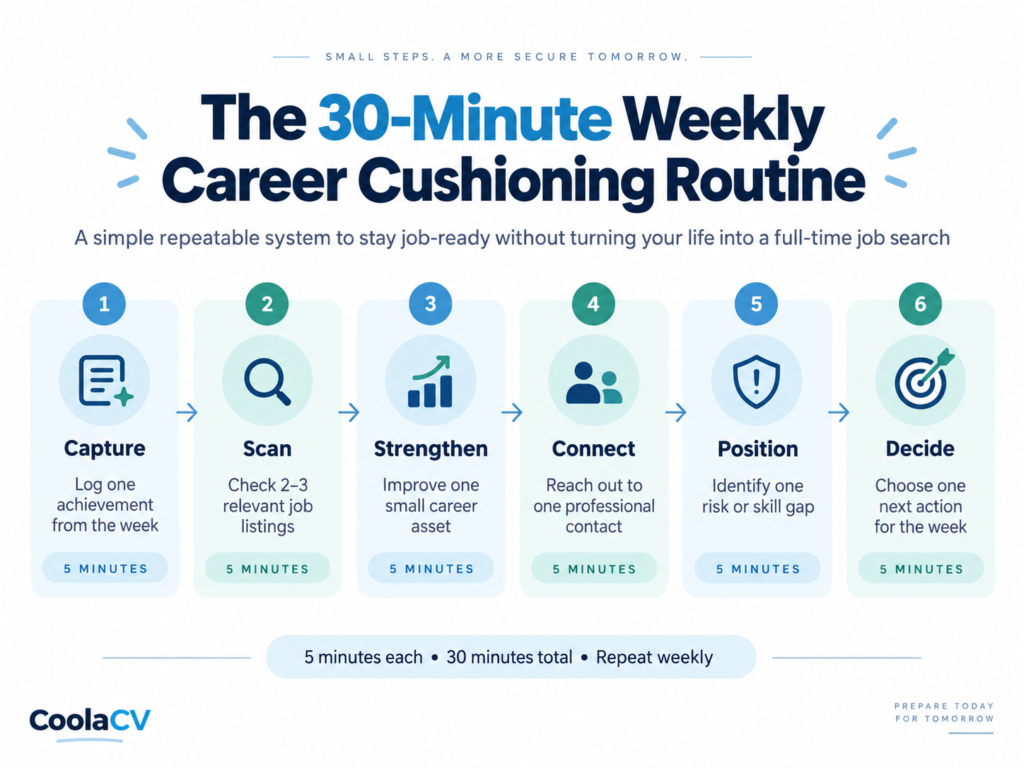
The 30-Minute Career Cushioning Routine
Break the session into six five-minute blocks:
5 minutes — Capture
5 minutes — Scan
5 minutes — Strengthen
5 minutes — Connect
5 minutes — Position
5 minutes — Decide
You can do this on Friday afternoon before closing your laptop, on Sunday evening while planning the week, or whenever you have a predictable half-hour. The exact day matters less than the repetition.
The aim is not to overhaul your career every week. It is to make one small improvement in each important area so that, over time, your career stays warm rather than going cold.
Minutes 0–5: Capture What You Actually Achieved This Week
This may be the most valuable five minutes in the entire routine.
Open a simple document called something like Career Wins and record anything from the week that might later become useful CV evidence. Do not focus on routine responsibilities. Capture evidence of impact.
Perhaps you fixed a recurring problem, completed a project, received positive feedback, saved time, reduced an error, improved a process, trained someone, handled a difficult client, increased sales, improved performance, managed a deadline, introduced a new tool, or solved something nobody else wanted to touch.
Write it down while you still remember the details.
Instead of:
Helped improve monthly reporting.
Record:
Rebuilt the monthly reporting process using Power BI, reducing preparation time from approximately six hours to two.
Do not worry about polishing the sentence perfectly. The objective is simply to preserve the evidence while the numbers, context, and outcome are still fresh in your mind.
This matters because strong CVs are usually built from accumulated evidence, while weak CVs are often written retrospectively from memory. And memory has a habit of turning meaningful work into vague phrases such as “responsible for reports and other administrative duties.”
Your weekly achievement log prevents that. After one year, you could easily have 40 or 50 specific examples of your contribution sitting in one document.
That is a serious career asset created five minutes at a time.
Minutes 5–10: Scan the Market
Do not start applying.
Just look.
Search for two or three roles that are similar to yours or represent where you might want to move next. You are trying to answer three simple questions: What are employers asking for? What language are they using? Is my profession changing?
Suppose you are a Business Analyst. A few months ago, employers may have emphasised requirements gathering, process mapping, stakeholder management, and SQL. Now you start noticing Power BI, automation, AI-assisted workflows, and product analytics appearing more frequently.
That does not mean you suddenly need five new certifications.
It simply gives you an early signal about where your market may be moving.
The earlier you notice these changes, the easier they are to respond to. You can learn gradually, strengthen your positioning, or simply observe whether the trend continues before investing significant time or money.
Keep a short Market Signals note. Each week, write down only one thing you noticed.
For example:
Week 1: Power BI appears in three analyst vacancies.
Week 2: More roles request Agile experience.
Week 3: Salary ranges appear to be moving towards £55k–£65k.
Week 4: Several employers mention AI-assisted reporting.
One observation each week eventually creates something much more useful than vague career anxiety:
market awareness.
Minutes 10–15: Strengthen One Career Asset
Now improve one small thing.
Not your entire CV.
One thing.
You could rewrite one weak CV bullet, add one measurable achievement, update one LinkedIn section, add a new skill, remove outdated information, improve your professional headline, save a useful work example, update a portfolio project, document a certification, or clean up one old job description.
The temptation is often to decide:
“This weekend I am completely rewriting my CV.”
Three hours later, the document is still open and you are comparing fonts.
Small improvements are easier to maintain. After ten weeks, ten weak sections have been improved without one painful CV marathon.
Use what I would call the Evidence Test whenever you update something:
Does this tell people what I did, or does it show what changed because I did it?
For example:
Weak:
Responsible for managing customer complaints.
Better:
Managed escalated customer complaints across a portfolio of 120 accounts.
Stronger:
Redesigned escalation handling across 120 customer accounts, reducing average resolution time by 23%.
The strongest version gives an employer something they can actually evaluate. It shows scope, responsibility, and outcome instead of simply listing a duty.
Minutes 15–20: Maintain One Professional Relationship
Networking becomes awkward when the only time someone hears from you is:
“Hi James, hope you’re doing well. By the way, do you know anyone hiring?”
That is not really networking.
That is emergency extraction.
A career cushion includes relationships that exist before you need anything. Use five minutes to contact one person: a former colleague, an old manager, someone you studied with, a recruiter you genuinely found helpful, someone you met at an event, or a professional contact whose work interests you.
The message does not need to be strategic or transactional.
Something as simple as:
Saw your update about the new role — congratulations. Looks like an interesting move. Hope it’s going well.
Or:
Your post about automation reminded me of the project we worked on at XYZ. Hope things are going well with you.
The objective is not to ask for a favour. It is to avoid allowing every professional relationship outside your current workplace to quietly disappear.
One message per week works out at roughly 50 meaningful touchpoints per year. That is a professional network built without spending your evenings “networking.”
Minutes 20–25: Check Your Position
This part is slightly uncomfortable, but useful.
Ask yourself:
If I had to look for another role tomorrow, what would be my biggest weakness?
Do not create a list of fifteen weaknesses. Choose one.
Perhaps your CV is outdated. Maybe your salary knowledge is poor, your technical skills are becoming dated, or you lack recent examples of leadership. You may also realise that your LinkedIn profile is vague, your network exists almost entirely inside your current employer, or you have not interviewed in five years.
Once you identify the weakness, ask:
What is one small thing I could do about that this week?
Suppose you notice that nearly every role you want requires Power BI and you have never used it. Your next move is not:
Become a Power BI expert by Friday.
It might simply be:
Complete the first hour of a beginner Power BI course this week.
Career resilience is usually built through dozens of small adjustments, not dramatic reinventions.
Minutes 25–30: Make One Career Decision
End the routine with an action.
Not more research.
Not another tab.
A decision.
Choose one thing you will do before the next session.
It could be:
Apply:
“I found one genuinely suitable vacancy. I will tailor my CV and apply.”
Learn:
“I will complete one SQL lesson this week.”
Document:
“I need the final performance numbers from the project I completed.”
Connect:
“I will message my previous manager.”
Update:
“I will rewrite my LinkedIn About section.”
Observe:
“I am going to watch whether remote vacancies continue declining in my field.”
You do not need to make a major career move every week. Sometimes the right decision is simply to do nothing yet and keep watching.
That is still different from being unaware.
Your Entire Weekly System
The routine should eventually feel almost mechanical.
0–5 minutes: CAPTURE
What did I achieve this week?
5–10 minutes: SCAN
What is happening in my job market?
10–15 minutes: STRENGTHEN
What small career asset can I improve?
15–20 minutes: CONNECT
Who should I maintain contact with?
20–25 minutes: POSITION
Where am I becoming vulnerable or more valuable?
25–30 minutes: DECIDE
What is my one next action?
Then stop.
The stopping is important because career cushioning should make you feel more prepared, not create another source of endless optimisation. You are trying to maintain readiness, not turn your career into a permanent project.
The Rule That Makes This Work: Never Start From Zero
This is the real advantage of the system.
Imagine two people are told on Monday that their department is being restructured.
The first person has not touched their CV since getting the job four years ago. Their LinkedIn profile still describes their previous position, they cannot remember the numbers behind their biggest achievements, they have not spoken with former colleagues in years, and they have no idea what similar positions currently pay.
Their first week is spent rebuilding everything.
The second person has been spending 30 minutes each week maintaining their career cushion. They already have a current achievement log, reasonably updated CV content, knowledge of market salaries, recent examples of employer requirements, active professional relationships, and a clearer understanding of where their skills fit.
The second person is not necessarily more talented.
They are simply less dependent on perfect timing.
That is what career cushioning should achieve.
You Do Not Need to Apply for Jobs Every Week
This deserves emphasis.
Career cushioning is not permanent job searching. If you enjoy your role, work for a good employer, and see opportunities to progress, great.
Your weekly routine might involve almost no applications at all. You could spend six months simply documenting achievements, watching your market, maintaining relationships, and strengthening your skills.
Then an unexpected opportunity appears.
Instead of saying:
“That looks interesting, but my CV is completely outdated.”
you are ready to evaluate it properly.
That is the difference between desperately searching for your next job and being professionally prepared for your next opportunity.
Watch for These Five Career Cushioning Triggers
Your normal weekly routine is deliberately light. But certain signals should cause you to pay closer attention.
1. Your responsibilities keep increasing but your progression does not
More work is not automatically career growth. If your responsibilities expand while your title, compensation, and development remain frozen, it is worth understanding what that increased experience is worth elsewhere.
That does not mean you immediately leave. It simply means you should know whether your growing contribution is being recognised appropriately.
2. Your industry is changing faster than your skills
Technology rarely sends a polite email announcing:
“Your current expertise will become considerably less valuable in approximately 18 months.”
The warning usually appears gradually in job descriptions. New tools start appearing, expectations shift, and certain skills become more common.
Pay attention early.
That gives you time to adapt without panic.
3. Your company becomes unusually focused on cost
One efficiency initiative means very little. But repeated hiring freezes, cancelled projects, budget restrictions, leadership departures, and reorganisations deserve awareness.
Not panic.
Awareness.
The point of career cushioning is to notice patterns early enough to make thoughtful decisions rather than reactive ones.
4. Your professional network has become your employer directory
If almost everyone who knows your work currently works in your company, your external network may need attention. This matters because career opportunities often come through people who already understand your capabilities.
A strong external network does not need to be huge. It simply needs to exist.
5. You would struggle to explain your recent value
Ask yourself:
“What are the three strongest things I achieved during the last twelve months?”
If you cannot answer fairly quickly, your weekly achievement log becomes a priority. You may be doing excellent work, but if you cannot explain or evidence it, that value becomes harder to communicate during a job search.
What Not to Do
A career cushioning routine can easily become another anxiety machine if you approach it badly.
Do not check job boards every day “just in case”
Market awareness is useful. Compulsive vacancy checking usually is not.
You only need enough exposure to notice meaningful changes, not enough to make yourself feel permanently behind.
Do not apply to everything
Ten weak applications do not automatically create more opportunity than two thoughtful ones. Career cushioning should improve your ability to recognise good opportunities, not encourage you to chase every vacancy.
Do not collect certifications without a reason
A certification is not automatically valuable because it exists. If employers in your target roles are not requesting it, make sure you understand why you are investing the time and money.
Learning should support your positioning, not become another form of procrastination.
Do not suddenly become a LinkedIn motivational speaker
You do not have to publish five times per week to maintain a healthy professional presence. A complete profile, useful engagement, and genuine relationships can be enough.
Visibility is useful.
Performance theatre is optional.
Do not let career cushioning damage your current performance
Your current job is still part of your future CV. Doing excellent work remains one of the best career strategies available.
Career cushioning should sit quietly alongside your current role, not distract you from it.
Build a Simple Career Cushion Folder
You do not need complicated software.
Create one folder with five items:
1. Master CV
Your complete career history and strongest achievements.
2. Career Wins
Your weekly achievement log.
3. Market Signals
Skills, salaries, and requirements you keep seeing.
4. Target Roles
A few job descriptions representing where you might move next.
5. Networking Notes
People you want to stay connected with.
That small folder becomes your personal career operating system. When you eventually need to tailor your CV for a specific vacancy, you are no longer staring at a blank document trying to remember what you accomplished in March 2024.
The evidence already exists.
The Monthly 30-Minute Review
Every fourth week, slightly change the routine.
Instead of doing the normal six blocks, use your 30 minutes to zoom out and look for patterns.
Ask yourself:
What skill appeared most often in job descriptions this month?
What achievement from this month belongs on my CV?
Has my estimated market value changed?
Which professional relationship should I strengthen?
Am I becoming more valuable in my current role?
If the right opportunity appeared tomorrow, would I be ready?
You are not trying to predict the future.
You are checking whether your career is drifting somewhere you did not consciously choose.
There is a difference.
After Six Months, This Becomes Surprisingly Powerful
Thirty minutes does not sound like much.
That is precisely why it works.
Thirty minutes per week for six months gives you approximately 13 hours of deliberate career maintenance. During that period, you could accumulate more than 20 documented achievements, dozens of observations about your job market, several improved CV sections, 20 or more professional touchpoints, clearer awareness of your skill gaps, and a much more accurate understanding of your external value.
More importantly, you remove much of the panic from career change.
Your CV does not need resurrecting. Your network does not need rebuilding. Your achievements do not need reconstructing from memory, and your understanding of the market is not based on the last time you applied for a job.
You are already warm.
Career Cushioning Is Not About Expecting the Worst
There is a slightly gloomy interpretation of career cushioning:
Always prepare to be fired.
That is not particularly useful.
A better interpretation is:
Never allow one employer to become your entire career strategy.
Companies change. Managers leave. Industries evolve. Technology changes jobs, and sometimes you simply change.
A role that suited you beautifully three years ago may eventually stop being where you want to spend the next three. Maintaining options does not make you disloyal.
It makes you responsible for your own career.
And the routine does not require hours of applications, awkward networking, or constant worry about what might happen. It requires half an hour.
Once a week.
Capture. Scan. Strengthen. Connect. Position. Decide.
Then return to your life.
Because the best career cushion is not having one foot permanently outside the door. It is knowing that if the door ever closes or a better one unexpectedly opens, you are ready to move.