Writing an internship or graduate CV can feel awkward because you are trying to prove your potential when your work experience may still be loading.
You may not have managed a team, saved a company thousands, or led a major project yet. That is fine. Employers hiring interns and graduates are not expecting a ten-year career history. What they are looking for is evidence: evidence that you can learn, communicate, solve problems, take initiative, and grow into the role.
A standout internship or graduate CV does not pretend you have more experience than you do. It presents what you already have in a clear, confident, and job-relevant way.
Why internship and graduate CVs are different
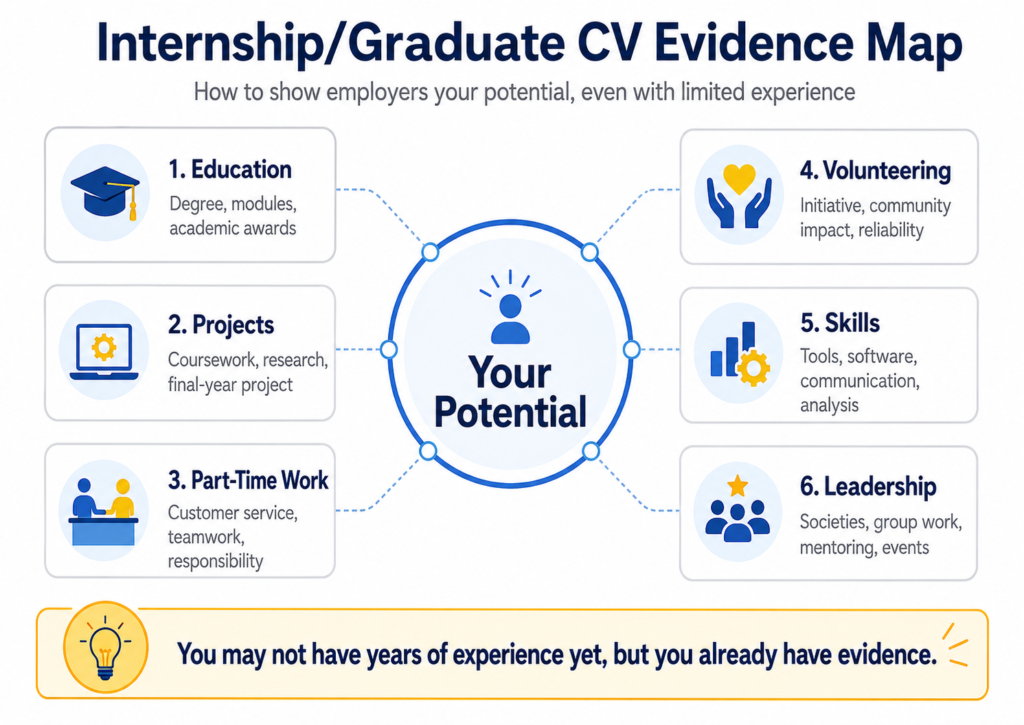
A CV for an experienced professional usually focuses on career achievements, leadership, and measurable business results. An internship or graduate CV is different because the strongest evidence may come from coursework, projects, volunteering, part-time work, societies, competitions, or personal initiatives.
That does not make your CV weak. It simply means you need to translate your experience properly.
For example, “worked in retail” can become evidence of customer service, problem-solving, communication, sales awareness, cash handling, teamwork, and working under pressure. A university project can show research skills, technical ability, presentation skills, data analysis, creativity, or leadership.
The problem is not always lack of experience. Sometimes, it is poor packaging.
Start with a focused CV headline
Your CV should quickly show what you are aiming for. Avoid vague labels like “student seeking opportunity” or “hardworking graduate.” They are too broad and do not help the recruiter understand your fit.
Use a simple headline that connects your education, target role, and strongest skill area.
Examples:
Business Management Graduate | Interested in Marketing, Operations, and Data-Driven Strategy
Computer Science Student | Seeking Software Engineering Internship | Python, JavaScript, and SQL
Finance Graduate | Strong Excel, Research, and Financial Analysis Skills
This helps your CV feel intentional. Recruiters should not have to guess what type of opportunity you want.
Write a short profile that sells your potential
Your personal profile should not be a life story. It should be a brief summary of your academic background, relevant strengths, and career direction.
A weak profile says:
I am a hardworking and motivated graduate looking for an opportunity to develop my skills.
That sentence appears on too many CVs. It sounds polite, but it does not say much.
A stronger version would be:
Business Management graduate with experience in market research, academic consulting projects, and customer-facing part-time work. Skilled in data analysis, report writing, teamwork, and presenting recommendations. Seeking a graduate role where I can support business growth, process improvement, and customer-focused decision-making.
This version gives the employer something to work with. It shows direction, skills, and relevance.
Put education near the top
For internship and graduate applications, education is usually one of your strongest selling points. Place it near the top of your CV, especially if you have limited work experience.
Include your degree, university, expected or completed graduation date, and relevant modules if they support the role.
For example:
BSc Computer Networks and Cybersecurity
University Name | Expected 2026
Relevant modules: Network Security, Database Systems, Python Programming, Cloud Computing, Risk Management
Do not list every module you have ever taken. Choose the ones that match the internship or graduate scheme. For a data analyst role, include statistics, databases, programming, research methods, or business analytics. For a marketing role, include consumer behaviour, digital marketing, branding, research, or communications.
Turn coursework into evidence
Many students underestimate academic projects. A strong project section can make your CV much more competitive, especially when you lack formal industry experience.
Instead of writing:
Final Year Project: Cybersecurity report
Write:
Cybersecurity Risk Assessment Project
Conducted a risk assessment of a simulated business network, identifying vulnerabilities in access control, password management, and data protection practices. Produced a structured report with practical recommendations to reduce security exposure and improve compliance awareness.
This shows what you did, how you thought, and why it matters.
Good project bullet points often include:
Action + skill + outcome
Examples:
“Analysed survey data using Excel to identify customer preference trends and presented findings to a class panel.”
“Designed a basic website prototype using HTML, CSS, and JavaScript to improve user navigation for a student business concept.”
“Worked in a team of five to develop a marketing plan, including competitor analysis, customer segmentation, and campaign recommendations.”
The goal is not to exaggerate. The goal is to make the value visible.
Include part-time jobs, even if they seem unrelated
A common mistake is removing part-time work because it does not match the target industry. But internship and graduate employers often value transferable skills.
Retail, hospitality, tutoring, administrative support, volunteering, childcare, delivery work, or campus jobs can all show employability.
For example, instead of:
Sales Assistant
Worked in a shop and helped customers.
Write:
Sales Assistant
Provided customer support in a fast-paced retail environment, handled product enquiries, processed transactions accurately, and worked with team members to maintain store standards during busy periods.
That is not “just retail.” That is communication, attention to detail, teamwork, and pressure management.
For a graduate CV, transferable skills matter. Employers want to know you can show up, learn quickly, work with people, and handle responsibility.
If you are struggling to identify what counts as experience, this guide on entry-level CV proof signals explains how to turn coursework, volunteering, part-time jobs, and personal projects into credible evidence employers can trust.
Make your skills section specific
A skills section should not be a random list of nice words. Avoid filling it with generic terms like:
Hardworking
Reliable
Team player
Motivated
Good communication
Fast learner
These qualities are fine, but almost everyone claims them. Instead, use skills that are more searchable, specific, and connected to the job description.
For example:
Technical skills: Excel, PowerPoint, SQL, Python, Canva, Google Analytics, Tableau, WordPress
Research skills: Literature review, survey design, data collection, report writing
Business skills: Market analysis, customer segmentation, presentation development, process improvement
Communication skills: Customer service, stakeholder communication, academic presentations, teamwork
This makes your CV easier to scan and more likely to match applicant tracking system keywords.
Tailor your CV to each internship or graduate role
This is where many applicants lose points. They create one CV and send it everywhere.
A general CV may feel efficient, but it often performs poorly because it does not speak directly to the role. Graduate recruiters usually review many applications. If your CV looks like it could be sent to marketing, finance, HR, cybersecurity, engineering, and operations all at once, it may not feel convincing for any of them.
Before applying, read the job description carefully and identify the repeated themes.
Look for keywords such as:
Data analysis
Customer service
Stakeholder management
Problem-solving
Project coordination
Research
Attention to detail
Commercial awareness
Communication
Microsoft Excel
Leadership potential
Then reflect those keywords naturally in your profile, skills, project descriptions, and experience bullets.
This does not mean copying the job description word for word. It means showing that your experience matches what they are asking for.
Use achievement-style bullet points
Even if you do not have major achievements, your bullets should still be active and outcome-focused.
Weak bullet:
“Responsible for helping customers.”
Stronger bullet:
“Supported customers with product enquiries, resolved basic issues, and maintained a positive service experience during peak shopping periods.”
Weak bullet:
“Did group presentation.”
Stronger bullet:
“Collaborated with four classmates to research market trends and deliver a 15-minute presentation with recommendations for a new product launch.”
Weak bullet:
“Used Excel for assignment.”
Stronger bullet:
“Used Excel to organise, clean, and analyse survey data, helping identify patterns in customer preferences.”
Start bullet points with strong verbs such as:
Analysed
Created
Supported
Led
Coordinated
Researched
Presented
Improved
Designed
Assisted
Developed
Organised
Reviewed
Managed
Your CV should sound active, not passive.
Add numbers where possible
Numbers make your CV more credible. You may not always have big metrics, but you can still quantify your experience.
Examples:
“Supported up to 50 customers per shift.”
“Worked as part of a five-person project team.”
“Delivered a 10-minute presentation to a class of 30 students.”
“Reviewed 20 academic sources for a research report.”
“Created three social media content samples for a student marketing campaign.”
Small numbers are still useful because they give scale. They help the recruiter understand what you actually did.
Show leadership without needing a leadership title
You do not need to be president of a society to show leadership. Leadership can appear in small actions.
You may have:
Organised a group project
Helped a new team member
Took responsibility for a presentation section
Coordinated a class task
Managed deadlines
Supported a community activity
Solved a problem without being asked
Trained someone informally
Graduate employers are often looking for leadership potential, not executive-level leadership. Show moments where you took initiative.
For example:
“Coordinated task allocation for a group assignment, helping the team complete research, slides, and presentation delivery before the deadline.”
That is leadership.
Keep the design clean and professional
A standout CV does not need dramatic colours, graphics, or decorative fonts. In fact, too much design can work against you, especially if the employer uses an applicant tracking system.
Use a clean layout with clear headings:
Profile
Education
Relevant Projects
Work Experience
Skills
Volunteering or Leadership
Certifications
Keep your CV to one page if you are applying for internships and early graduate roles, especially if you have limited experience. A two-page CV can work if you have several relevant projects, placements, certifications, or strong work history, but do not stretch it just to look impressive.
White space is not your enemy. A cramped CV is tiring to read. Recruiters are busy people, not treasure hunters.
Avoid common internship and graduate CV mistakes
The biggest mistake is being too generic. A CV that says “I am hardworking, passionate, and eager to learn” may be true, but it does not separate you from other candidates.
Another mistake is hiding useful experience. Many students leave out coursework, projects, volunteering, or part-time work because they think it is not “professional enough.” If it proves a relevant skill, it belongs on the CV.
Also avoid using overly complicated formatting, long paragraphs, unexplained acronyms, spelling errors, and the same CV for every role.
Your CV should answer one question clearly:
Why are you a strong early-career candidate for this specific opportunity?
Example structure for an internship/graduate CV
Here is a simple structure you can follow:
Name and Contact Details
Include your name, phone number, email address, LinkedIn, and portfolio or GitHub link if relevant.
CV Headline
A short line showing your target role and key strength.
Profile
Three to five lines summarising your background, relevant skills, and career direction.
Education
Degree, university, dates, relevant modules, academic achievements if useful.
Relevant Projects
Academic, personal, technical, research, or business projects linked to the role.
Work Experience
Part-time jobs, internships, placements, volunteering, campus work, freelance work.
Skills
Technical skills, tools, languages, research skills, business skills, communication skills.
Leadership, Volunteering, or Activities
Societies, mentoring, community work, competitions, student ambassador roles.
Certifications
Short courses, LinkedIn Learning, Google certificates, cybersecurity labs, Excel training, coding bootcamps, or other relevant learning.
For additional examples, Indeed’s career guide also provides practical internship CV examples and formatting guidance for students and early-career applicants.
Final thoughts
A standout internship or graduate CV is not about pretending to be more experienced than you are. It is about showing evidence of readiness.
Employers know you are still growing. What they want to see is that you can think clearly, communicate well, learn quickly, solve problems, and bring value from day one.
So, do not write your CV like an apology for not having enough experience. Write it like a focused introduction to your potential.
Your experience may be early, but it is not empty. You just need to present it with confidence, relevance, and proof.