
At the start of your career, your CV often needs to prove that you can do the job.
By mid-career, the goal changes.
Your CV now needs to prove that you have made things better.
That is where many experienced professionals get stuck. They list duties, responsibilities, systems, meetings, processes, stakeholders, and tools. All useful, yes. But not always persuasive.
A mid-career CV should not read like a job description with your name at the top. It should read like evidence.
You are no longer simply saying, “I was responsible for this.” You are showing, “This is what changed because I was there.”
That shift is the difference between a CV that explains your role and a CV that sells your value.
Why Mid-Career CVs Often Go Flat
Mid-career professionals usually have plenty of experience. That is rarely the problem.
The problem is that experience is often described too passively.
For example:
Responsible for managing client relationships and supporting project delivery.
There is nothing wrong with this sentence, but there is also nothing memorable about it. It tells the reader what the role involved, but not how well you did it, what you improved, or why it mattered.
Now compare it with:
Strengthened client relationships across key accounts by improving communication rhythms, resolving delivery issues early, and supporting smoother project completion.
Better.
Now add measurable or visible impact:
Strengthened client relationships across key accounts by improving communication rhythms and resolving delivery issues early, contributing to smoother project completion and repeat client engagement.
That version gives the recruiter something to work with. It shows action, judgment, and outcome.
Mid-career hiring is not just about whether you can perform tasks. It is about whether you can be trusted with complexity, people, pressure, change, and results.
Your CV needs to reflect that.
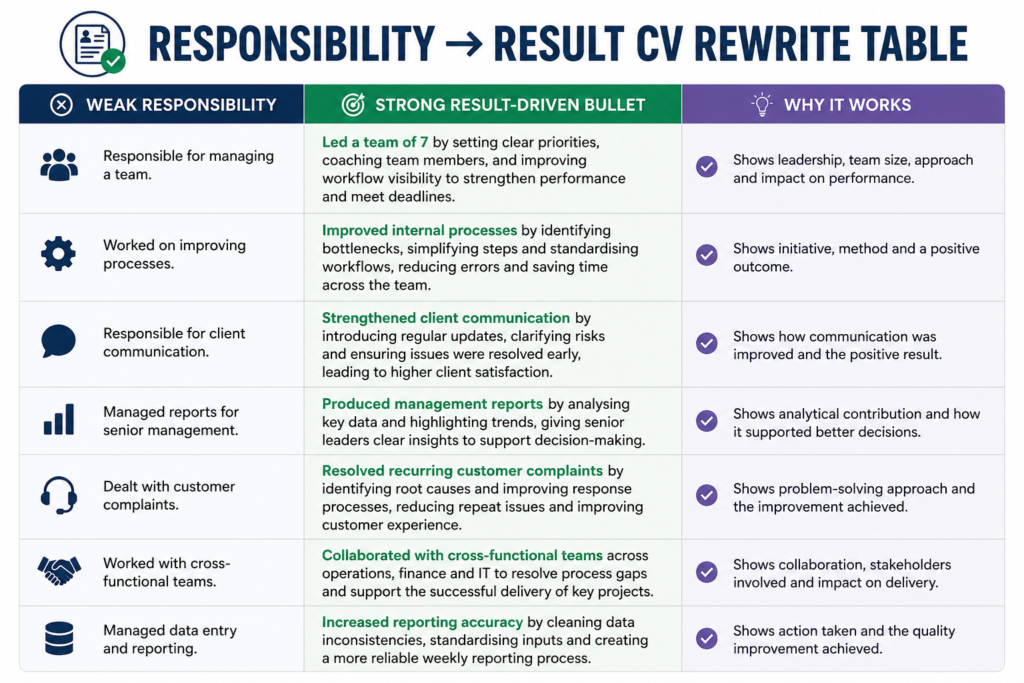
Responsibilities Tell. Results Prove.
A responsibility describes what you were expected to do.
A result shows what happened because of how you did it.
That distinction matters because most candidates applying for the same role will have similar responsibilities. Many project managers manage projects. Many operations managers improve operations. Many finance professionals prepare reports. Many HR professionals support recruitment, employee relations, or policy work.
The stronger question is:
What did you improve, reduce, increase, prevent, simplify, influence, deliver, save, build, fix, or lead?
That is where your value sits.
A responsibility says:
Managed weekly reporting for senior leadership.
A result says:
Improved weekly leadership reporting by consolidating data from multiple sources, reducing manual follow-up and giving senior stakeholders clearer visibility of project risks.
A responsibility says:
Handled customer complaints.
A result says:
Resolved recurring customer complaints by identifying service gaps, escalating root causes, and improving response consistency across the team.
A responsibility says:
Supported recruitment activities.
A result says:
Supported recruitment across multiple roles by coordinating interviews, improving candidate communication, and helping reduce delays in the hiring process.
You do not always need huge numbers. Not every result is a dramatic “saved £3 million before lunch” situation. Real work is often quieter than that. But there should still be a sense of movement.
Something was unclear, slow, risky, inefficient, inconsistent, delayed, manual, costly, or underperforming.
Then you did something.
Then it improved.
That is the story your CV needs to tell.
The Mid-Career CV Rewrite Formula
A simple way to turn responsibilities into results is to use this structure:
Action + area of work + method + outcome
For example:
Improved onboarding processes by creating clearer documentation and coordinating handovers, helping new starters become productive more quickly.
Let us break that down.
Action: Improved
Area of work: Onboarding processes
Method: Creating clearer documentation and coordinating handovers
Outcome: Helping new starters become productive more quickly
This formula works because it stops you from writing vague bullet points. It forces every sentence to show contribution.
Here are more examples.
Instead of:
Responsible for managing supplier relationships.
Write:
Improved supplier coordination by setting clearer expectations, tracking delivery issues, and maintaining regular communication to reduce disruption to business operations.
Instead of:
Worked with cross-functional teams.
Write:
Collaborated with cross-functional teams across operations, finance, and technology to resolve process gaps and support smoother delivery of business priorities.
Instead of:
Managed data entry and reporting.
Write:
Increased reporting accuracy by cleaning data inconsistencies, standardising inputs, and creating a more reliable weekly reporting process.
Instead of:
Led a team of five.
Write:
Led a team of five by clarifying responsibilities, coaching team members, and improving workflow visibility to support stronger day-to-day performance.
Notice the difference. The rewritten versions do not just describe the job. They show leadership, ownership, and practical impact.
Use Numbers, But Do Not Worship Them
Metrics are powerful on a CV. They give your claims weight.
Numbers such as percentages, revenue, cost savings, turnaround times, team size, project value, customer volume, error reduction, or delivery timelines can make your achievements more credible.
For example:
Reduced monthly reporting time by 30% by automating spreadsheet checks and simplifying duplicate review steps.
That is strong because it is specific.
But not every valuable achievement comes with a neat number. Some work improves trust, reduces confusion, strengthens compliance, prevents mistakes, or makes collaboration easier. These are still results.
When exact figures are unavailable, use honest scale indicators:
- across 4 departments
- for a team of 12
- across multiple client accounts
- during a system migration
- under tight regulatory deadlines
- supporting senior leadership decisions
- across high-volume daily operations
For example:
Improved communication between operations and finance teams during month-end reporting, reducing repeated queries and supporting faster issue resolution.
No percentage. Still useful.
The goal is not to decorate your CV with random numbers. The goal is to make your contribution clear, believable, and relevant.
A CV full of exaggerated metrics can feel like a sales brochure wearing a suit. Keep it credible.
Find Results Hidden in Everyday Work
Many mid-career professionals underestimate their achievements because they think results must be award-winning or dramatic.
They do not.
Results often hide inside ordinary work.
Ask yourself:
What problems did people bring to me repeatedly?
What process did I make easier?
What mistakes did I help prevent?
What did I organise when things were messy?
What did I explain, translate, or simplify for others?
Where did I save time, reduce confusion, or improve quality?
What did managers trust me to handle?
What would have gone wrong if I had not done my job well?
That last question is especially useful.
Sometimes your value is not only in what you created. It is in what you prevented.
You may have prevented missed deadlines, compliance issues, customer dissatisfaction, poor handovers, duplicated work, system errors, stock shortages, reporting mistakes, or team burnout.
That counts.
For example:
Maintained service continuity during staff shortages by reprioritising workloads, supporting team coverage, and escalating risks early.
That is a result. It shows calm, judgment, and reliability.
Mid-career employers value that because they are often hiring you to reduce problems, not create more meetings about them.
Replace Weak CV Language With Stronger Verbs
The language of your CV matters.
Phrases like “responsible for,” “assisted with,” “helped with,” and “involved in” are not always wrong, but they can make your experience sound passive.
Stronger alternatives include:
- Led
- Delivered
- Improved
- Reduced
- Increased
- Strengthened
- Coordinated
- Streamlined
- Resolved
- Introduced
- Built
- Supported
- Managed
- Developed
- Standardised
- Optimised
- Influenced
- Analysed
- Implemented
For example, instead of:
Helped with improving customer service processes.
Write:
Improved customer service processes by reviewing recurring issues, updating response templates, and supporting more consistent handling of customer queries.
Instead of:
Assisted managers with reports.
Write:
Prepared management reports by analysing operational data, highlighting trends, and supporting better decision-making.
Of course, do not overstate your role. If you supported something, say supported. If you led it, say led. The strongest CVs are confident without becoming fictional. Recruiters can smell fiction. So can hiring managers. Sometimes through a PDF.
Tailor Results to the Role You Want Next
A mid-career CV rewrite is not just about improving old bullet points. It is about positioning yourself for the next step.
That means not every achievement deserves the same space.
If you are targeting leadership roles, emphasise team management, decision-making, stakeholder influence, change delivery, and performance improvement.
If you are targeting operations roles, emphasise efficiency, process improvement, service delivery, risk reduction, and cross-functional coordination.
If you are targeting technology roles, emphasise systems, automation, testing, data, implementation, problem-solving, and user impact.
If you are targeting project roles, emphasise delivery, timelines, budgets, risks, dependencies, governance, and stakeholder communication.
The mistake is trying to include everything you have ever done. A CV is not your career autobiography. It is a strategic document.
Mid-career professionals often need to remove older or less relevant details so the strongest evidence can stand out. Your Saturday job from 2006 may have built character, but unless it connects to the role, it probably does not need premium space anymore.
Focus on what supports your next move.
Build Achievement Bullets That Recruiters Can Scan
Recruiters rarely read CVs like novels. They scan for relevance, clarity, and proof.
That means your bullet points should be easy to absorb quickly.
A strong mid-career achievement bullet usually includes:
What you did
How you did it
Why it mattered
For example:
Streamlined invoice review by introducing a clearer tracking process, reducing duplicate follow-ups and improving visibility of outstanding payments.
This works because the reader can quickly understand the problem, your action, and the benefit.
Try to keep most bullet points to one or two lines. Long paragraphs under each job can bury your best evidence.
A good structure for each recent role is:
- One short role summary
- Four to six achievement-led bullet points
- Tools, systems, or specialist skills where relevant
For example:
Managed daily operations across a high-volume customer service environment, supporting team performance, issue resolution, and service quality.
Then the bullets show the evidence.
This gives context without turning your CV into a job manual.
Before and After: Responsibility to Result
Here are practical examples of how to rewrite common mid-career CV statements.
Before:
Responsible for managing a team and ensuring tasks were completed.
After:
Led daily team operations by assigning priorities, monitoring workload, and supporting staff performance to ensure deadlines and service standards were met.
Before:
Worked on improving internal processes.
After:
Improved internal processes by identifying bottlenecks, documenting clearer procedures, and reducing repeated errors across routine tasks.
Before:
Responsible for stakeholder communication.
After:
Strengthened stakeholder communication by providing regular updates, clarifying risks, and ensuring decision-makers had accurate information at key project stages.
Before:
Managed reports for senior management.
After:
Produced senior management reports by analysing operational data, highlighting trends, and presenting clear insights to support planning and decision-making.
Before:
Dealt with system issues.
After:
Resolved recurring system issues by investigating user reports, coordinating with technical teams, and improving issue-tracking visibility.
Each revised version gives the reader a stronger sense of value.
That is the point of a mid-career CV rewrite. You are not inventing achievements. You are uncovering them.
What to Remove From a Mid-Career CV
A stronger CV is not always a longer CV.
In fact, mid-career CVs often improve when unnecessary detail is removed.
Consider cutting or reducing:
- Old roles that no longer support your current direction
- Repetitive duties listed under every job
- Generic phrases such as “hardworking team player”
- Tasks that are too junior for the level you now want
- Outdated software or skills that do not add value
- Long personal statements full of broad claims
- Every training course you have ever attended
Your CV should make the reader think, “This person is ready for the role.”
It should not make them think, “This person has included every professional event since broadband was invented.”
Be selective.
The Professional Summary Also Needs Results
Many CV summaries are too generic.
For example:
Experienced professional with excellent communication skills and a proven ability to work independently and as part of a team.
This could describe almost anyone. It is polite, but it does not position you strongly.
A better mid-career summary might read:
Operations professional with 10+ years’ experience improving service delivery, coordinating cross-functional teams, and strengthening reporting processes in fast-paced environments. Known for turning complex workflows into clearer systems, resolving operational issues, and supporting senior leaders with practical, decision-ready information.
This version gives the reader a clearer picture of level, strengths, and value.
Your summary should answer three questions quickly:
Who are you professionally?
What do you specialise in?
What value do you bring?
Once that is clear, the rest of the CV should prove it.
Final Check: Does Your CV Show Movement?
Before sending your CV, read each bullet point and ask:
Does this show action?
Does it show value?
Does it show the level I want next?
Does it sound like me at my best?
Can the reader understand the result?
If the answer is no, rewrite it.
A strong mid-career CV does not simply say what you were paid to do. It shows how you made work better, easier, faster, safer, clearer, more accurate, more profitable, or more reliable.
That is what employers are really looking for.
They are not hiring a list of responsibilities.
They are hiring someone who can walk into complexity and create progress.
So, when rewriting your CV, do not stop at the duty.
Find the result.
That is where your career value becomes visible.
At mid-career level, your CV should not whisper, “I have experience.”
It should clearly show, “I know how to deliver.”
Responsibilities may get you understood. Results get you shortlisted.
CoolaCV helps professionals reshape their CVs around evidence, outcomes, and career direction, so the right value shows up before the interview even begins.