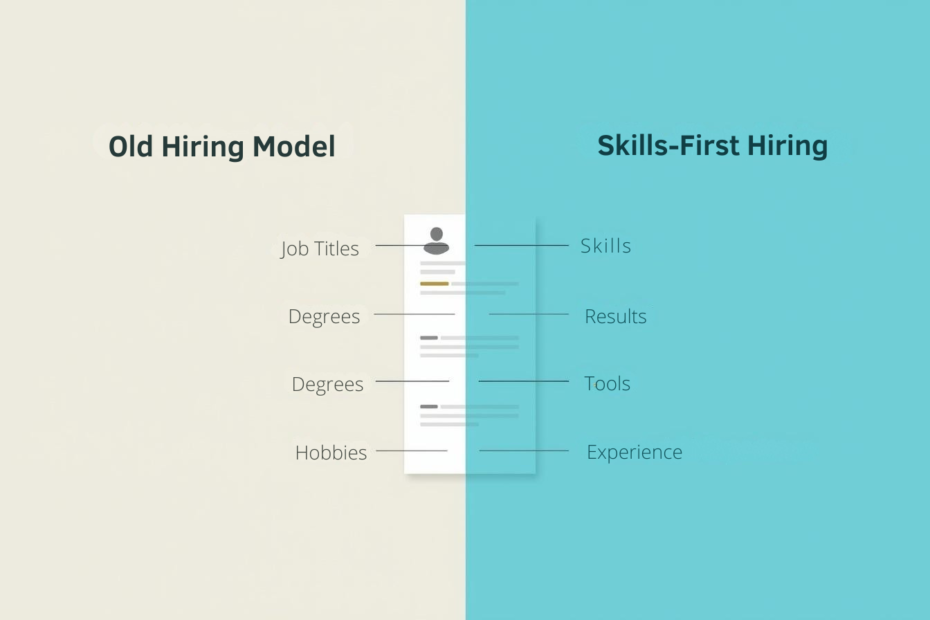
There was a time when getting shortlisted depended heavily on job titles, years of experience, and whether your CV looked like it had been blessed by corporate tradition.
That time is fading.
More employers are leaning into skills-first hiring which is a hiring approach that focuses less on where you worked or what your title was, and more on whether you can actually do the job. It is a shift that broadens the talent pool and puts more emphasis on demonstrated ability, transferable skills, and real-world capability.
For job seekers, this is both encouraging and slightly inconvenient.
Encouraging, because you may not need the “perfect” background to be considered.
Inconvenient, because many CVs are still written for the old system.
If your CV is mostly a list of duties, generic buzzwords, and job titles doing all the heavy lifting, you may be getting overlooked not because you are unqualified, but because your CV is not showing your value clearly enough.
Let’s fix that.
What is skills-first hiring?
Skills-first hiring is an approach where employers prioritize a candidate’s skills and demonstrated abilities over traditional filters like exact job titles, degree pedigree, or a perfectly linear career path.
Instead of asking, “Has this person held this exact role before?” employers are increasingly asking:
- Can this person perform the core tasks of the role?
- Do they have the relevant technical and soft skills?
- Can they show evidence of impact?
- Are their skills transferable into this position?
That means employers may care less about whether you were called “Operations Coordinator” or “Project Support Officer” and more about whether you can manage timelines, communicate with stakeholders, improve processes, use the right tools, and deliver results.
In plain English: your CV needs to stop relying on labels and start proving capability.
Why skills-first hiring matters
This shift matters because it changes what gets attention.
In a skills-first market, employers are often more open to candidates who are:
- changing careers
- returning to work after a break
- moving industries
- coming from nontraditional backgrounds
- self-taught or certified rather than following one tidy route
- stronger in actual ability than in impressive-sounding titles
This is especially useful for anyone who has ever thought:
“I can do this job, but my background doesn’t look like the usual one.”
That is exactly where a better CV makes a difference.
LinkedIn’s 2026 skills insights show that fast-growing skills are evolving quickly, and Indeed’s guidance continues to emphasize transferable skills as critical for career change and long-term employability.
What skills-first hiring is not
Let’s clear up one common misunderstanding.
Skills-first hiring does not mean experience no longer matters.
It does.
It also does not mean qualifications are irrelevant. In regulated or specialized roles, they still matter a great deal.
What has changed is the order of importance. More employers want evidence of capability earlier in the process, especially for roles where success depends on communication, digital tools, project execution, analysis, adaptability, and collaboration.
So no, you do not need to throw your work history overboard.
You just need to stop making it the only story your CV tells.
Signs your CV is still written for the old hiring model
Your summary is vague
If your profile says:
“Hardworking professional with excellent communication skills and a passion for success”
…that could describe half the internet.
Recruiters need clearer evidence than “hardworking.” Most people are not putting “occasionally disorganized under pressure” on their CV.
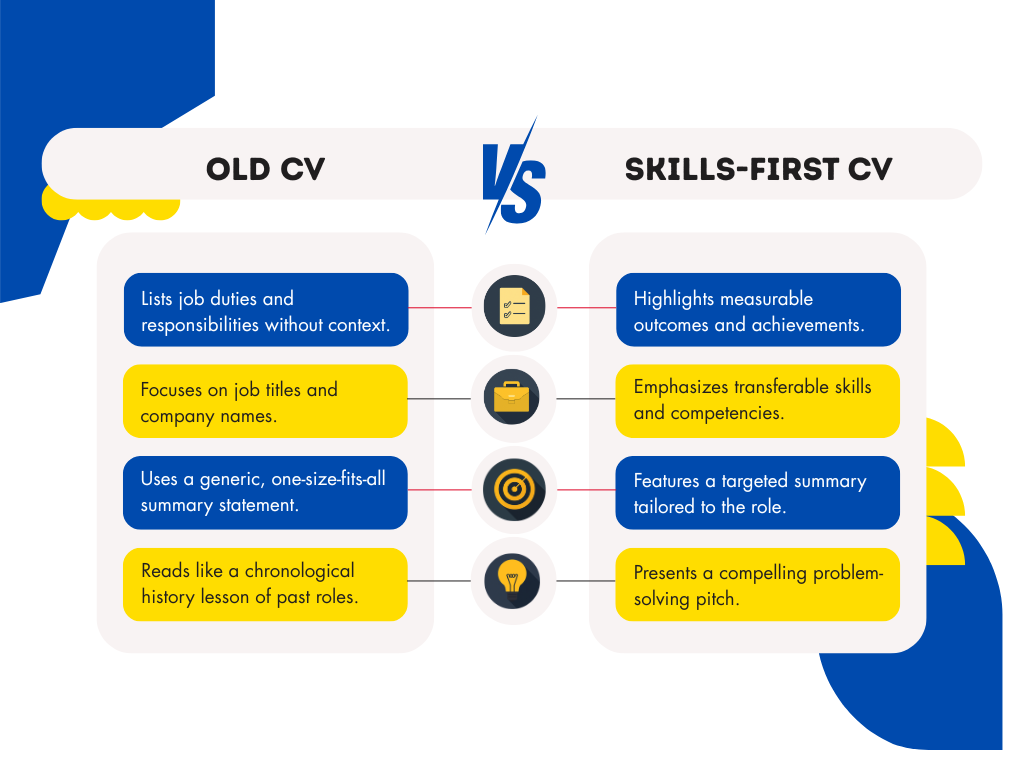
Your experience section reads like a job description
If your bullets say things like:
- Responsible for managing projects
- Worked with stakeholders
- Handled customer issues
- Supported business operations
…you are describing activity, not value.
Your skills section is disconnected from your work history
Listing “leadership,” “problem-solving,” and “teamwork” without proving them anywhere else is not persuasive.
Your CV emphasizes titles more than outcomes
A title gives context, but titles vary wildly across companies. Skills and results travel better.
You are underselling transferable experience
Projects, volunteer work, certifications, side work, and cross-functional tasks may contain the exact skills the employer wants but many candidates bury them.
How to rewrite your CV for skills-first hiring
1. Start with the job description, not your old CV
Before editing anything, study the role you want.
Look for:
- repeated skills
- tools and systems mentioned more than once
- action words
- business outcomes expected
- keywords tied to the role’s priorities
For example, if a job description repeatedly mentions:
- stakeholder communication
- process improvement
- project coordination
- reporting
- cross-functional collaboration
…those are signals.
Your CV should reflect the same language naturally and honestly, where it is true.
2. Rewrite your professional summary around capability
Your summary should quickly answer one question:
What can this person do well, and in what kind of environment?
Instead of this:
Experienced professional with a strong work ethic and excellent interpersonal skills.
Try this:
Detail-oriented project support professional with experience coordinating cross-functional tasks, improving workflows, and keeping deliverables on track in fast-paced environments. Skilled in stakeholder communication, documentation, reporting, and process support, with a track record of helping teams work more efficiently.
That sounds like someone who can contribute, not someone hoping the recruiter guesses.
3. Turn job duties into skill-and-impact bullets
This is one of the biggest improvements you can make.
A weak bullet says what you were assigned.
A strong bullet shows the skill you used and the result it created.
Instead of:
- Responsible for managing calendars and meetings
Try:
- Coordinated schedules, meetings, and follow-ups across multiple stakeholders, helping improve team organization and reduce scheduling conflicts
Instead of:
- Handled customer complaints
Try:
- Resolved customer issues through clear communication and timely follow-up, contributing to a better service experience and faster issue resolution
Instead of:
- Worked on testing software
Try:
- Executed manual and automated test cases, identified defects early in the release cycle, and supported smoother launches through structured QA processes
The pattern is simple:
Action + skill + context + result
4. Make your skills section smarter, not longer
A long skills section is not automatically a strong one.
Group your skills in a way that is easy to scan.
Core Skills
Project coordination, stakeholder communication, process improvement, reporting, documentation, requirements clarification
Technical Tools
Excel, Jira, Trello, Asana, SQL, Power BI, Salesforce, Zendesk
Operational Strengths
Problem-solving, workflow support, quality assurance, cross-functional collaboration, time management
List skills you can support elsewhere in the CV.
Do not claim “advanced Excel” if your current relationship with formulas is mostly stress and optimism.
5. Highlight transferable skills clearly
This is especially important if you are changing roles or industries.
Transferable skills are exactly what they sound like: abilities you can carry from one role to another. Indeed’s career guidance highlights these as especially valuable for people moving roles or industries.
Some examples include:
- communication
- coordination
- analysis
- documentation
- customer support
- leadership
- training
- quality control
- problem-solving
- scheduling
- compliance
- process improvement
Someone moving from customer service into project coordination may already have experience in:
- handling multiple priorities
- communicating with different stakeholders
- resolving problems quickly
- documenting issues
- managing expectations
- keeping tasks moving
That is not irrelevant experience. That is usable experience with poor marketing.
6. Add evidence, not just adjectives
Words like “excellent,” “dynamic,” and “proven” are fine in moderation, but evidence is stronger.
Where possible, show:
- numbers
- efficiency gains
- improvements
- volume handled
- time saved
- quality improvements
- scope of responsibility
- successful outcomes
For example:
- Supported testing across multiple releases, helping catch issues before deployment
- Improved documentation accuracy by maintaining clear process records and timely reporting
- Coordinated cross-team activities to keep deadlines on track
- Helped streamline workflow by organizing tasks, updates, and follow-ups
Even when you do not have exact numbers, concrete detail is still better than vague praise.
7. Use the language employers actually use
If the job description says “stakeholder management” and your CV says “worked with people,” you are making life harder than necessary.
Using employer language helps with:
- ATS matching
- recruiter recognition
- clearer alignment
- stronger relevance
This does not mean stuffing your CV with keywords until it sounds like a broken recruitment bot.
It means using familiar, accurate language that matches the role.
8. Consider a hybrid CV format if your background is non-linear
If you are pivoting careers, returning after a break, freelancing, or coming from a mixed background, a traditional chronological CV may not show your strengths well.
A hybrid CV can work better.
That format usually includes:
- a strong summary
- a targeted skills section near the top
- selected achievements or competencies
- work history after that
This lets the employer see your relevance before they start judging your timeline.
A quick before-and-after example
Before
Administrative Assistant
- Answered emails and phone calls
- Scheduled meetings
- Helped with reports
- Worked with other departments
After
Administrative Assistant
- Coordinated internal communication, scheduling, and follow-up across teams to support smooth daily operations
- Prepared reports and maintained documentation with strong attention to accuracy and deadlines
- Collaborated with multiple departments to keep tasks aligned and resolve administrative bottlenecks
- Supported workflow efficiency by organizing information, tracking actions, and ensuring timely updates
Same person. Much stronger positioning.
Final thought
Skills-first hiring creates opportunity for capable people whose backgrounds may not look “perfect” on paper.
But opportunity still needs visibility.
If your CV does not clearly show your skills, your strengths can still be missed.
So rewrite your CV with this in mind: less title worship, less vague fluff, more proof.
Because in this market, “I have experience” is not enough.
Your CV needs to say:
Here is what I can do, here is where I have done it, and here is why it matters.
That is the version recruiters are far more likely to remember.