Your LinkedIn About section is not decoration.
It is not a place to paste your CV summary, list every software tool you have ever touched, or announce that you are a “dynamic, results-driven professional” and hope the internet applauds politely.
It has a job.
A good LinkedIn About section should help the right person understand three things quickly:
Who you are.
What you are good at.
Why they should message you.
LinkedIn describes the About section as the place where you can express your mission, motivation, and skills to people who view your profile. It is different from your headline, which sits directly below your name. That difference matters. Your headline gets attention. Your About section builds enough trust for someone to reply, connect, refer, interview, or ask a follow-up question.
And yes, people do read it.
Not everyone. Not always. Not line by line with a cup of tea and emotional support biscuits.
But recruiters, hiring managers, potential clients, collaborators, and useful professional contacts often scan it when they are deciding whether you are relevant enough to contact. Columbia University’s LinkedIn profile guide also recommends using the About section to describe your work, explain why it matters, avoid simply pasting a professional bio, and include a call to action.
That is the part many people miss.
A LinkedIn About section that gets replies is not just well-written. It is reply-friendly.
It gives the reader an easy reason to say:
“Your background looks relevant.”
“Are you open to a conversation?”
“Would you be interested in this role?”
“Can you send your CV?”
“Could we discuss this project?”
That is the goal.
Why Most LinkedIn About Sections Do Not Get Replies
Most About sections fail for one of four reasons.
First, they are too vague.
They say things like:
I am a hardworking and passionate professional with strong communication skills and a proven track record of success.
This sounds professional, but it says almost nothing. It could belong to a project manager, nurse, data analyst, teacher, HR officer, business owner, or someone trying to escape a group project.
Second, they are too CV-like.
They repeat job titles, tasks, and dates without giving the reader a reason to care.
Third, they are too cold.
They sound like they were written by a committee that has never met a human being.
Fourth, they have no direction.
Even when the profile is impressive, the reader does not know what to do next. Should they contact you about roles? Collaborations? Consulting? Speaking? Mentoring? Referrals? Nothing? Are you open? Are you hiding? Are you simply admiring your own profile from a safe distance?
Your About section should remove that uncertainty.
The Simple Structure That Works
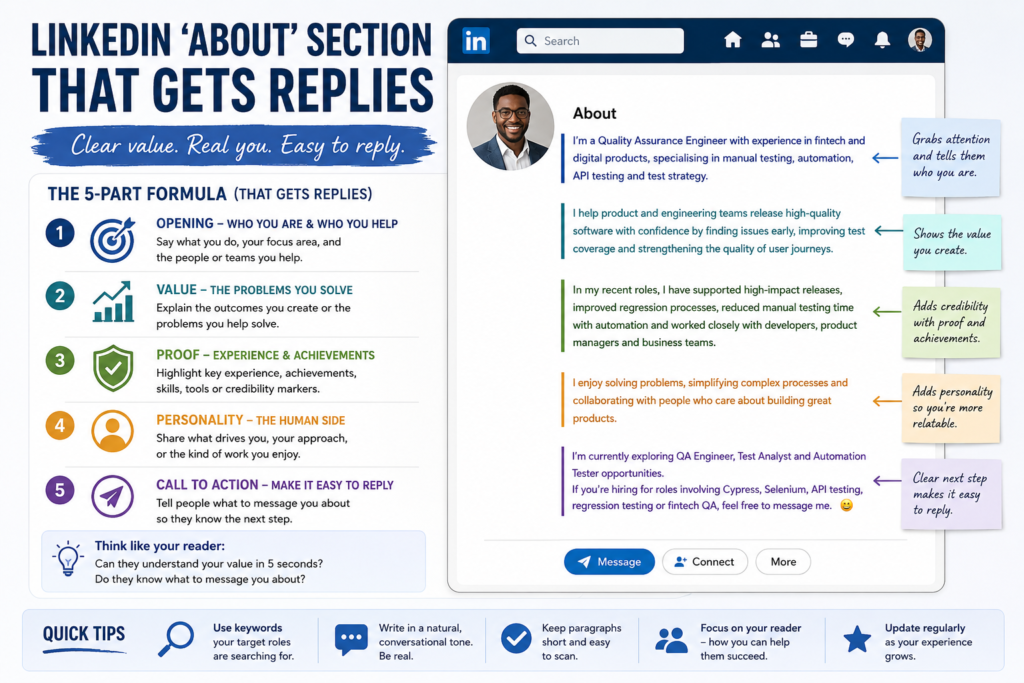
The best LinkedIn About sections usually follow this structure:
Opening line: Say what you do and who you help.
Value: Explain the problems you solve or the results you create.
Proof: Mention relevant experience, strengths, industries, tools, achievements, or credibility markers.
Personality: Add a human touch so you sound approachable.
Call to action: Tell the right people how to contact you or what to contact you about.
That is it.
You do not need to sound like a TED Talk. You need to sound clear, useful, and easy to message.
Here is the basic formula:
I help [audience/employer/team/customer] achieve [result] by [what you do best].
Over the past [number] years, I have worked across [industry/function/role type], where I have [key achievement or strength].
My strengths include [skill 1], [skill 2], and [skill 3]. I am especially interested in [target area/type of role/problem].
Feel free to connect or message me about [specific opportunity, role, project, collaboration, or topic].
This structure works because it answers the questions already forming in the reader’s mind.
Can this person help with my problem?
Are they relevant?
Do they have proof?
Are they approachable?
What should I message them about?
Now let us turn that into practical copy-paste formulas.
Formula 1: The Job Seeker Who Wants Recruiters to Reply
Use this if you are actively looking for a role and want recruiters or hiring managers to understand your target quickly.
Copy-paste formula:
I am a [job title/function] with experience in [industry/sector], specialising in [top 2–3 strengths].
I help teams [main result], whether that means [example 1], [example 2], or [example 3].
In my recent roles, I have [achievement/result], [achievement/result], and [achievement/result]. I enjoy work that combines [skill/strength] with [skill/strength], especially in environments where [type of challenge or value].
I am currently exploring opportunities in [target roles/sector/location/remote preference].
If you are hiring for roles involving [keyword 1], [keyword 2], or [keyword 3], feel free to message me.
Example:
I am a Quality Assurance Engineer with experience in fintech and digital product environments, specialising in manual testing, regression testing, API testing, and test automation.
I help product and engineering teams release with more confidence by finding defects early, improving test coverage, and strengthening the quality of user journeys before they reach production.
In my recent roles, I have supported high-impact releases, improved regression processes, and worked closely with developers, product managers, and business teams to reduce avoidable production issues. I enjoy work that combines technical problem-solving with clear communication, especially in fast-moving teams where quality needs to keep pace with delivery.
I am currently exploring QA Engineer, Test Analyst, and Automation Tester opportunities.
If you are hiring for roles involving Cypress, Selenium, Postman, API testing, regression testing, or fintech QA, feel free to message me.
Why this works:
It uses recruiter-friendly keywords without turning the profile into a keyword cupboard. It also gives the recruiter a clear reason to reach out.
Formula 2: The Mid-Career Professional Who Wants Better Opportunities
Use this if you are not desperate to leave tomorrow morning but want your profile to attract stronger opportunities.
Copy-paste formula:
I am a [profession] with [number]+ years of experience helping organisations [main business outcome].
My work sits at the intersection of [area 1], [area 2], and [area 3]. I am often trusted to [responsibility at your level], improve [process/system/team outcome], and support [stakeholder/business/customer need].
Highlights from my work include [achievement 1], [achievement 2], and [achievement 3].
I am especially interested in opportunities where I can help [target organisation/team] solve [specific problem] and deliver [specific result].
Open to relevant conversations about [roles/projects/sectors].
Example:
I am an operations and service delivery professional with 10+ years of experience helping organisations improve processes, manage teams, and deliver more consistent customer outcomes.
My work sits at the intersection of people, systems, and performance. I am often trusted to bring structure to busy environments, improve workflow visibility, and support senior leaders with practical information they can actually use.
Highlights from my work include improving reporting routines, reducing repeated service issues, supporting cross-functional delivery, and helping teams work with clearer priorities.
I am especially interested in opportunities where I can help growing organisations solve operational bottlenecks and deliver smoother, more reliable service.
Open to relevant conversations about operations management, service improvement, team leadership, and process transformation roles.
Why this works:
Mid-career profiles need to show maturity. This formula does not shout. It demonstrates value, judgment, and readiness for bigger responsibility.
Formula 3: The Career Changer Who Needs to Connect the Dots
Career changers often make one big mistake: they talk too much about what they are leaving and not enough about what they are bringing.
Your About section should build a bridge.
Copy-paste formula:
I am transitioning from [previous field] into [target field], bringing a strong background in [transferable skill 1], [transferable skill 2], and [transferable skill 3].
In my previous work, I developed experience in [relevant responsibility], [relevant responsibility], and [relevant responsibility], which now supports my move into [target role/industry].
I have been building my capability in [new tools/skills/certifications/projects], with a focus on [specific target area].
What connects my past and next step is [common theme: problem-solving, analysis, people, systems, service, risk, communication].
I welcome conversations with people hiring or working in [target field], especially around [role type/opportunity].
Example:
I am transitioning from healthcare administration into data analysis, bringing a strong background in reporting, operational problem-solving, stakeholder communication, and service improvement.
In my previous work, I developed experience in managing information, identifying process gaps, preparing reports, and supporting decisions in busy service environments. Those skills now support my move into data-focused roles where accuracy, interpretation, and practical insight matter.
I have been building my capability in Excel, SQL, Power BI, and data visualisation, with a focus on turning raw information into clear, decision-ready reporting.
What connects my past and next step is simple: I like making messy information useful.
I welcome conversations with people hiring or working in data analysis, reporting, business intelligence, or operations analytics.
Why this works:
It does not apologise for changing careers. It explains the logic. That is what readers need.
Formula 4: The Consultant, Freelancer, or Service Provider
If you want people to enquire about your service, your About section should be sharper. You need to make the problem, outcome, and next step obvious.
Copy-paste formula:
I help [specific audience] achieve [specific result] without [pain point/frustration].
Most of my work focuses on [service 1], [service 2], and [service 3]. Clients usually come to me when they are struggling with [problem], [problem], or [problem].
My approach is [brief method or philosophy]. Instead of [common bad approach], I focus on [better approach].
Typical projects include [example 1], [example 2], and [example 3].
Message me if you need help with [specific service/problem].
Example:
I help job seekers improve their CVs, cover letters, and LinkedIn profiles without turning them into robotic, keyword-stuffed documents that sound like everyone else’s.
Most of my work focuses on ATS-friendly CV optimisation, career storytelling, application reviews, and LinkedIn profile rewrites. Clients usually come to me when they know they have experience, but their documents are not getting enough replies.
My approach is practical: clarify the target role, uncover the strongest evidence, improve structure, and rewrite the content so employers can see the value quickly.
Typical projects include CV rewrites, cover letter reviews, LinkedIn About sections, and application checks before submission.
Message me if you need a second pair of eyes before you apply.
Why this works:
It speaks to a real pain point. It also sounds human. Very important. Nobody wants to message a brochure.
Formula 5: The Student or Early-Career Candidate
Early-career candidates often worry they do not have enough experience. But your About section can still show direction, energy, and relevance.
Copy-paste formula:
I am a [student/recent graduate/early-career professional] in [field], interested in [target area].
Through my studies, projects, volunteering, internships, or work experience, I have developed skills in [skill 1], [skill 2], and [skill 3].
I am especially interested in [specific problem, industry, or role type] because [short reason].
I am currently building experience in [tools/projects/skills] and looking for opportunities to contribute to [type of team/company/project].
Happy to connect with professionals, recruiters, and organisations working in [field].
Example:
I am a final-year marketing student interested in digital marketing, brand strategy, and content-led growth.
Through my coursework, student projects, and part-time work, I have developed skills in research, social media content, campaign planning, customer communication, and performance analysis.
I am especially interested in how brands build trust online because good marketing should do more than make noise; it should help the right people understand the right value.
I am currently building experience in SEO, email marketing, Canva, Google Analytics, and content planning, and I am looking for internship or entry-level opportunities where I can contribute, learn, and grow.
Happy to connect with marketing professionals, recruiters, and organisations working in digital marketing, content, or brand communications.
Why this works:
It avoids pretending to have 15 years of experience when you clearly do not. Instead, it shows direction and potential.
Formula 6: The Quiet Professional Who Hates “Selling Themselves”
Some people dislike writing about themselves because it feels awkward. Fair. Not everyone wakes up thinking, “Today I shall become a personal brand.”
This formula is simple, grounded, and still effective.
Copy-paste formula:
I work in [field/role], where I focus on [main responsibility or value].
My strengths are [strength 1], [strength 2], and [strength 3]. I enjoy roles where I can [type of contribution] and help teams [result].
Over time, I have built experience in [area 1], [area 2], and [area 3].
I am interested in connecting with people in [industry/function] and learning about opportunities involving [target area].
Example:
I work in finance administration, where I focus on accurate reporting, organised records, and reliable support for business operations.
My strengths are attention to detail, follow-through, and making information easier for others to use. I enjoy roles where I can bring order to busy processes and help teams avoid unnecessary errors or delays.
Over time, I have built experience in invoicing, reconciliations, data entry, supplier communication, and management reporting.
I am interested in connecting with people in finance, operations, and business support, and learning about opportunities involving reporting, process improvement, or finance administration.
Why this works:
It is calm and credible. You do not have to sound loud to sound valuable.
The First Three Lines Matter Most
The opening of your LinkedIn About section is crucial because many readers will only scan the first few lines before deciding whether to continue.
Avoid opening with:
Welcome to my profile.
This wastes valuable space. People already know where they are.
Also avoid:
I am passionate about excellence and committed to delivering results.
It is too broad.
Try one of these instead:
I help growing teams turn messy operations into clearer, more reliable processes.
I am a QA Engineer focused on helping product teams release cleaner, safer software.
I help job seekers turn strong experience into CVs and LinkedIn profiles that employers can understand quickly.
I am a healthcare administrator moving into data analysis, with a focus on reporting, insight, and better decision-making.
I support senior leaders with clear reporting, organised workflows, and practical problem-solving.
The best opening line should make the right reader think:
“That sounds relevant.”
Not “What does that mean?”
Add Proof Without Sounding Like You Are Reading Your CV Aloud
Before you rewrite your LinkedIn About section, make sure your CV already shows clear achievements rather than plain duties — this guide on turning responsibilities into results can help you sharpen the evidence first. Your About section needs proof, but it should not become a full work history.
Good proof includes:
- Years of experience
- Industries worked in
- Types of teams supported
- Tools or systems used
- Measurable achievements
- Certifications
- Projects
- Specialist knowledge
- Problems solved
- Stakeholders worked with
Weak proof sounds like this:
I have excellent communication skills and work well under pressure.
Better proof sounds like this:
I regularly work with product managers, developers, and business stakeholders to clarify requirements, test critical user journeys, and reduce avoidable release risks.
Even better:
In one recent role, I helped improve regression testing coverage and reduced manual testing time by introducing clearer test routines and reusable automation scripts.
Proof does not have to be dramatic. It has to be specific.
Make It Easy for People to Reply
This is where many LinkedIn About sections fall apart.
They explain the person beautifully, then end with nothing.
No invitation. No direction. No signal.
A strong closing line can increase replies because it lowers the effort for the reader. Instead of making them guess what to say, you give them a natural opening.
Here are copy-paste call-to-action lines:
Feel free to message me about roles involving [skill], [skill], or [skill].
I am open to conversations about [target role], [industry], and [type of opportunity].
If my background looks relevant to a role you are hiring for, I would be happy to connect.
Message me if you need support with [specific service/problem].
I am always happy to connect with professionals working in [field/industry].
Recruiters can contact me about [role titles] in [location/remote/hybrid preference].
If you are building a team around [specialism], I would be glad to have a conversation.
A reply-friendly About section is not pushy. It is simply clear.
Keywords Matter, But Do Not Write for Robots Only
LinkedIn is searchable, so keywords matter.
But your profile still needs to make sense to humans.
The trick is to include natural keywords that match your target roles. For example:
For a project manager:
project delivery, stakeholder management, risk management, governance, planning, budgets, Agile, reporting, change management
For a QA engineer:
manual testing, automation testing, Cypress, Selenium, Postman, API testing, regression testing, test cases, defect management, Jira
For an HR professional:
employee relations, recruitment, onboarding, policy, performance management, HR administration, workforce planning, employee engagement
For a data analyst:
SQL, Excel, Power BI, dashboards, reporting, data cleaning, data visualisation, business intelligence, insights
Use these words naturally across your About section. Do not dump them at the bottom like abandoned luggage.
A good keyword sentence might look like:
My experience includes stakeholder management, risk tracking, delivery planning, governance reporting, and coordinating cross-functional teams through complex project milestones.
That reads naturally and still supports search visibility.
Before and After Example
Before:
I am an experienced professional with a strong background in administration, customer service, and team support. I am hardworking, reliable, and passionate about helping organisations succeed. I have excellent communication skills and can work well independently or as part of a team. I am currently looking for a new opportunity where I can use my skills and grow professionally.
This is not terrible. It is just too general.
After:
I am an administrative and operations support professional with experience helping busy teams stay organised, communicate clearly, and keep day-to-day work moving.
My strengths include coordinating information, managing records, supporting customers, preparing reports, and helping teams reduce confusion around routine processes. I enjoy work where accuracy, follow-through, and calm problem-solving make a visible difference.
In previous roles, I have supported managers, handled customer queries, maintained documentation, coordinated schedules, and helped improve the flow of information between teams.
I am currently interested in administrative, operations support, customer service, and business support roles where I can contribute to a reliable and well-organised team.
Feel free to connect or message me about relevant opportunities.
The second version is stronger because it gives context, value, skills, direction, and a clear invitation.
Common Mistakes to Avoid
Do not write in the third person unless there is a strong reason.
“Taiwo is an experienced professional…” can sound distant on a personal LinkedIn profile. First person usually feels warmer and more natural.
Do not start with your life story.
You do not need to begin with childhood dreams unless your childhood dream was unusually relevant and legally safe to discuss.
Do not use empty adjectives.
Words like passionate, motivated, dynamic, strategic, and results-driven are only useful when supported by evidence.
Do not make it all about what you want.
“I am looking for a role where I can grow” is fine, but employers also want to know what you can help them improve.
Do not forget the next step.
A reader should know whether to message you about jobs, partnerships, freelance work, speaking, mentoring, referrals, or industry networking.
A 20-Minute LinkedIn About Section Rewrite Plan
Here is a simple way to rewrite your About section without turning it into a weekend project.
Minute 1–5: Define your target
Write down three roles, industries, or opportunity types you want to attract.
Minute 6–10: List your proof
Write five achievements, projects, tools, responsibilities, or strengths that support that target.
Minute 11–15: Draft using a formula
Choose one formula from this article and fill in the blanks.
Minute 16–18: Add keywords naturally
Include role-specific keywords a recruiter or client might search for.
Minute 19–20: Add a clear call to action
End with one sentence telling people what they can message you about.
That is enough to move from “nice profile” to “this person looks relevant.”
Final Copy-Paste Master Template
Use this when you want one flexible version that works for most professionals.
I am a [role/profession] with experience in [industry/function], specialising in [skill 1], [skill 2], and [skill 3].
I help [teams/companies/clients/customers] achieve [result] by [how you create value]. My work often involves [responsibility 1], [responsibility 2], and [responsibility 3].
Highlights from my experience include [achievement 1], [achievement 2], and [achievement 3]. I am especially interested in [type of work/problem/sector] where I can contribute to [desired outcome].
Outside the job titles, I am someone who values [professional value], [professional value], and [professional value].
Feel free to connect or message me about [roles/projects/opportunities/topics].
Closing Thought
Your LinkedIn About section does not need to be clever.
It needs to be clear.
The goal is not to impress everyone. The goal is to make the right reader understand your value quickly enough to take the next step.
A strong About section says:
This is what I do.
This is how I help.
This is why I am credible.
This is what you can message me about.
That is what gets replies.
Not buzzwords. Not corporate fog. Not “passionate professional with a proven track record” copied from 2014 and still somehow roaming the internet.
Just clear value, written like a real person.
CoolaCV helps job seekers and professionals turn scattered experience into stronger CVs, LinkedIn profiles, and application documents that speak clearly to the roles they want next.